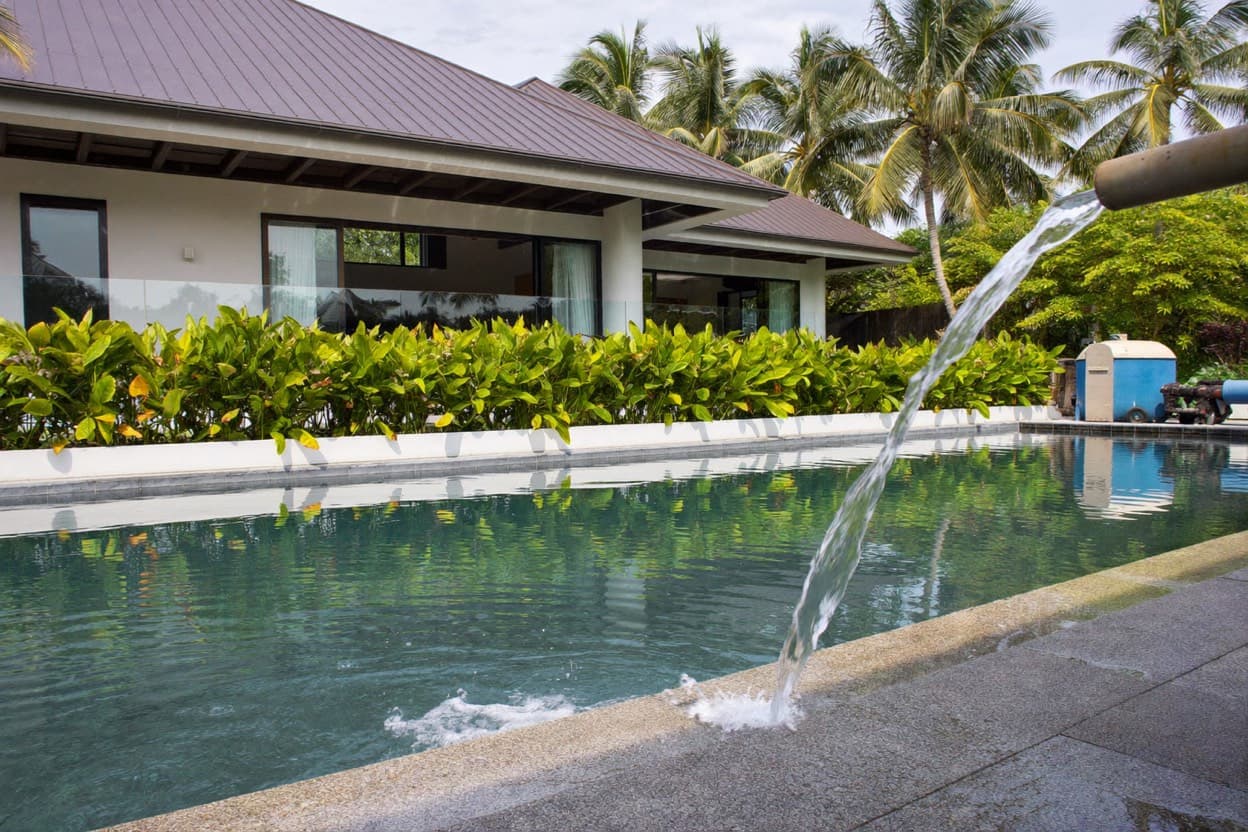
Every pool owner on the islands eventually does the arithmetic: the pool needs tens of thousands of litres to fill and a steady top-up forever after, trucked water costs money every single time, and there is a well in the garden. The instinct to connect the two is right. The pools that turn green or grow brown stains within weeks of filling are the ones where nobody checked what was actually in the water first.
A pool makes two different demands
The first fill is a one-off, enormous demand: a volume that dwarfs anything else the property ever asks for in a single job. Make-up water is the opposite, a modest ongoing trickle that replaces evaporation, splash-out and backwash, and it quietly peaks in the hot dry months when evaporation is hardest. These two demands deserve separate answers, and conflating them is how wells get abused.
No well should be asked to deliver the first fill at the hose's pace. The sustainable answer runs the well gently into storage for however long the fill honestly takes, letting the bore work at its tested yield around the clock while the pool fills from the tanks in stages. Where the timeline is fixed, a hybrid is often the practical call: a trucked first fill to open the pool on schedule, with the well carrying the make-up duty from day one. Make-up is where a well shines, because the daily volume is small and constant, exactly the demand shape a bore likes.
Pool chemistry meets groundwater chemistry
Pool water is deliberately oxidising: chlorine is there to burn organic matter. Put dissolved iron or manganese into that environment and the chlorine obligingly oxidises them too, which is how a crystal-clear fill turns tea-coloured overnight or paints brown and black stains onto the liner and grout. Island groundwater carries exactly these metals often enough that this is the classic well-fed-pool failure, and it is invisible beforehand because dissolved metals show no colour in the bucket.
Hardness is the slower second problem. Very hard fill water pushes the pool toward scale at the waterline and inside heat pumps, and it drags the owner into constant chemical correction. None of this argues against well water. It argues for a water test before the first fill, and for treating the fill line to remove what the test finds, usually sediment and metals, before the water ever meets chlorine.
The setup that works
- Test the well water before any fill decision, specifically for iron, manganese and hardness
- Fill from storage in stages, at the well's tested pace, not straight from the bore at full throttle
- Treat the fill and make-up line to the test result, so metals come out before chlorine finds them
- Route dry-season make-up through the same treated line, since evaporation peaks exactly when the well is under most load
- For rental villas, decide the first-fill source by the calendar: a truck buys the opening date, the well pays for every day after
Deep Well Samui tests well water, builds the treatment stage between bore and pool, and sizes storage so a fill never harms the well, across Samui, Phangan and Koh Tao. If a pool is being planned or an existing one is fighting stains, the water test is the first and cheapest move.