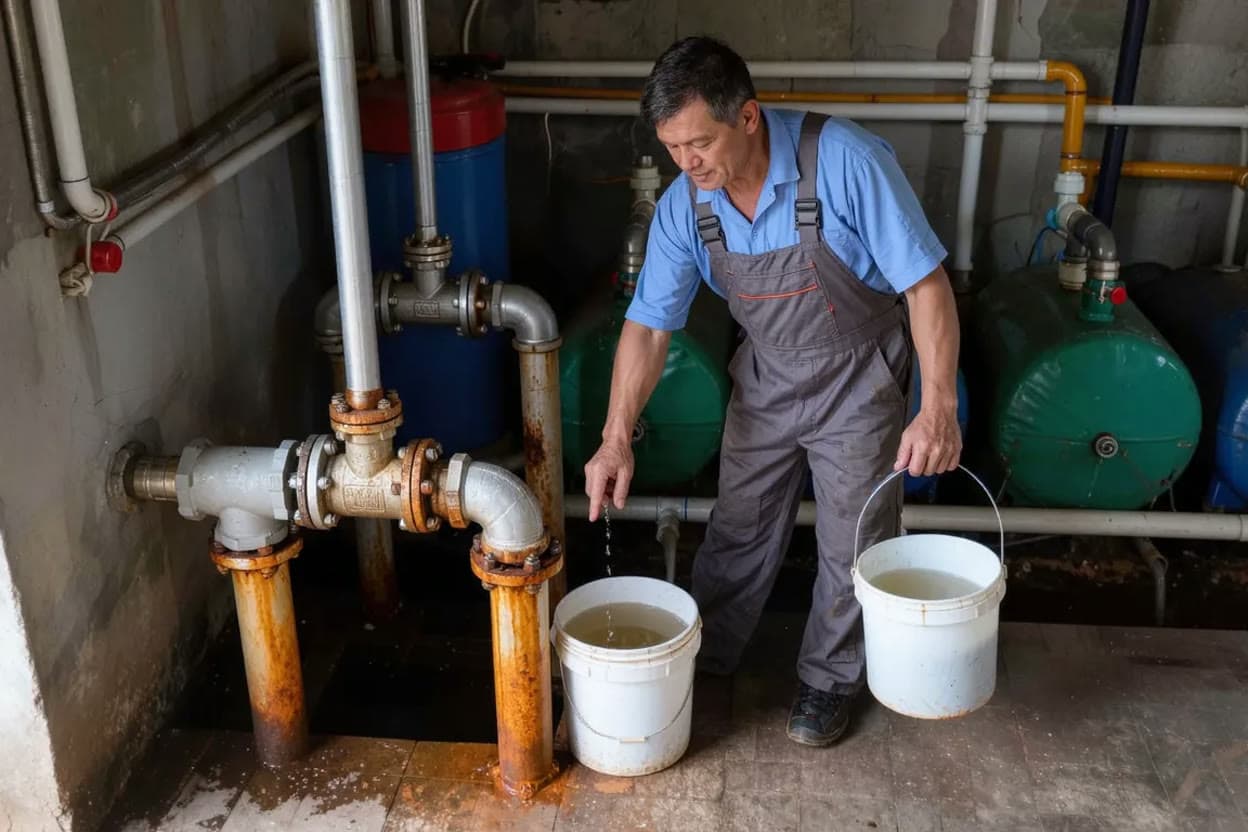
Orange rings in the toilet, brown streaks below a garden tap, laundry that never quite comes out white. On granite islands like Samui this usually points at two dissolved metals, iron and manganese, that the water picked up underground. Neither is unusual and both are treatable. The trap is buying a filter before understanding which problem you actually have.
Clear at the pump, orange in the tank
The confusing part for most owners is that the water often looks perfectly clear as it comes out of the well. Iron in groundwater is usually dissolved, held invisibly in the water the way sugar is held in coffee. Underground there is little oxygen, so it stays in that form.
Once the water reaches a storage tank, a standing pool or a bathroom fitting, it meets air. Oxygen converts the dissolved iron into solid particles of rust. Now the water carries a tint, the particles settle as orange-brown sludge, and every surface the water touches regularly begins to stain. Manganese behaves the same way but oxidises more slowly and stains darker, brown to black rather than orange.
Iron, manganese, or something else
Not every brown tap is a mineral problem, and treating the wrong cause wastes money. Several things look similar at first glance:
- Sediment. Sand or silt arrives as visible particles straight away and settles quickly in a glass, while dissolved metals colour the water only after it has stood in air
- Corroding pipework. Old steel fittings shed rust into otherwise clean water, and the colour then appears at some taps and not others
- Turbidity after heavy rain, which points at surface water reaching the bore. That is a sealing problem rather than a filtration problem and deserves prompt attention
- Iron bacteria. Slimy reddish deposits in cisterns and tanks point at bacteria feeding on iron, and they are treated differently from the dissolved metal itself
The staining itself gives useful clues. Orange marks on tiles and sanitaryware suggest iron. Dark brown or black staining, or black specks caught in tap aerators, suggest manganese. A metallic taste can accompany either. Clues are where a diagnosis starts, not where it ends.
Why guessing the filter is expensive
Iron removal is a staged process. The dissolved metal has to be oxidised into particles first, then the particles have to be caught in the right media, and the media has to be backwashed on the right schedule. How much oxidation the water needs, and which media suits it, depends on the iron level, the manganese level, the pH and the hardness. Those four numbers vary bore to bore, sometimes street to street.
Guess wrong and the failures are predictable. A simple cartridge filter catches nothing dissolved and clogs with rust particles instead. An undersized media vessel lets colour break through to the house. A softener asked to do an iron filter's job fouls its resin early. The order that works is unglamorous: test the water, design the stages to the result, then verify with a retest after installation.
What to do about it
Start with a laboratory test covering iron, manganese, hardness and pH at minimum. Take the sample properly: run the tap first, use a clean container, and sample water from the well itself rather than from a tank where oxidation has already started. With numbers in hand the treatment becomes a sizing exercise instead of an experiment, and the staining stops because the cause was removed rather than masked.
Deep Well Samui tests well water across Samui, Phangan and Koh Tao and designs treatment to the result. If fittings are staining and the water has never been tested, that is the first appointment worth making.