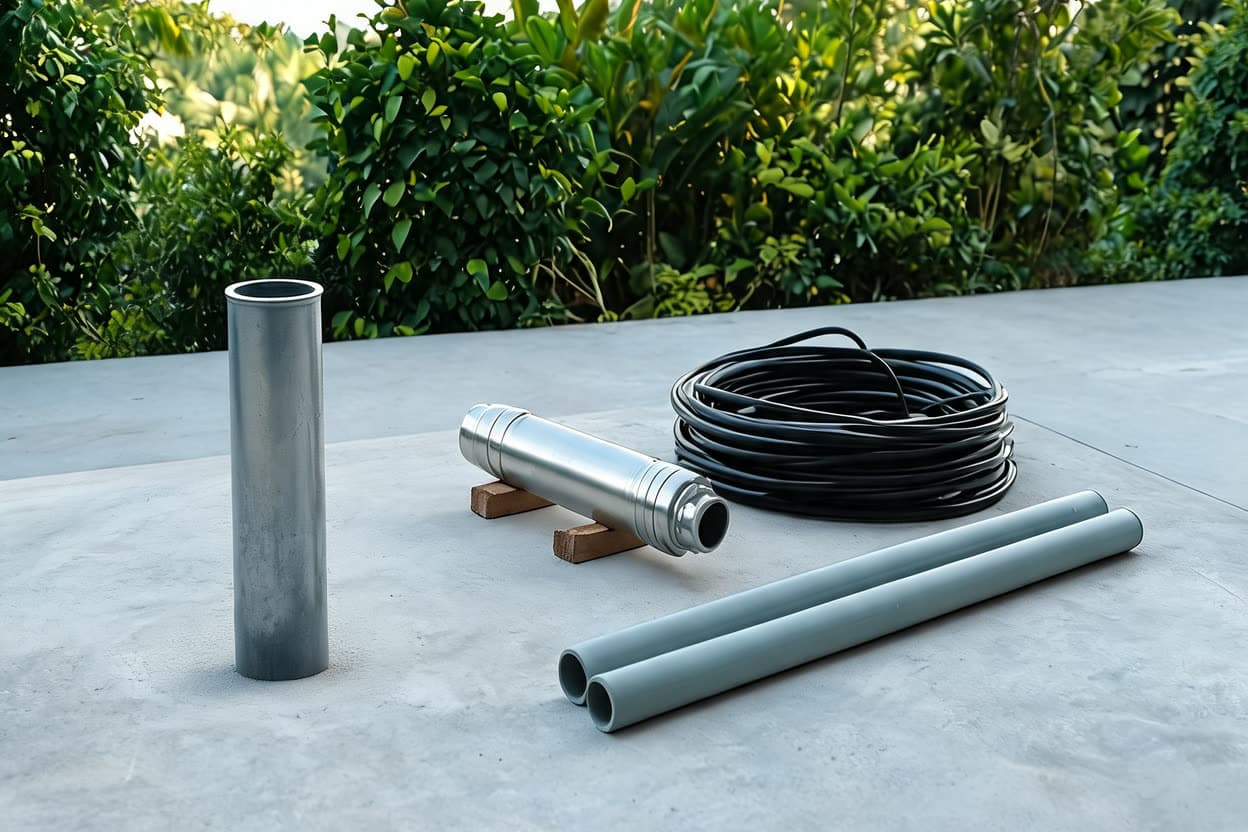
When two drilling quotes differ, diameter is often part of the reason. One contractor proposes a 4-inch well, another a 6-inch one, and the owner is left to guess whether the larger hole is better value or just a larger invoice. The honest answer depends on what the well needs to do. To see why, it helps to separate what diameter controls from what it does not.
What the number actually describes
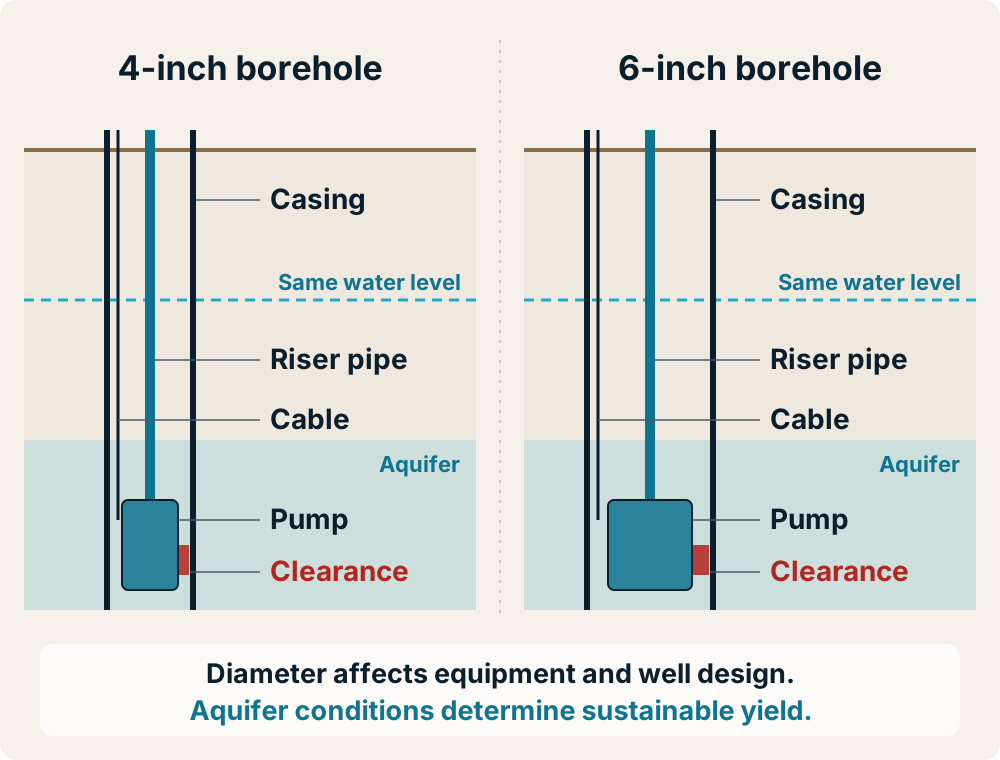
The figure on a quote usually refers to the casing, the pipe that lines the borehole and holds it open. Its inside diameter is the space everything else has to fit into: the submersible pump, the riser pipe that carries water up, the power cable, and any fittings along the way. The drilled hole itself is somewhat wider than the casing, because room is needed around the outside for the sanitary seal and for the casing to go in straight.
Diameter is therefore not the same as depth, yield, pump power or the size of the pipe that delivers water to the house. Those are separate design decisions. A 4-inch well can be deeper than a 6-inch one, and a 6-inch well can produce less water than a 4-inch well a few hundred metres away.
Why a wider hole does not mean more water
How much water a well can sustainably supply depends mainly on the ground it is drilled into: how much water the aquifer holds, how easily it moves through the rock or sediment, and how well the well was completed and developed. The diameter of the hole has only a small effect on that. Doubling the width does not double the yield, and on a poor site no diameter rescues the well.
What diameter does change
Submersible pumps are made in standard size classes named after the casing they are designed to fit, so the casing sets the pump range available. A 4-inch casing accepts 4-inch pumps, which cover the flows a house, a villa and many small properties need. A 6-inch casing accepts larger pumps as well, which matters when the well is expected to supply high flows: a resort, several villas from one bore, or heavy irrigation.
Clearance is the second difference. A pump that fills most of the casing has little room for the cable and riser couplings alongside it, and a slightly crooked hole can make installation and removal awkward. More room makes servicing easier and leaves space for inspection cameras and rehabilitation tools later in the well's life.
Clearance has a limit in the other direction too. A submersible motor is cooled by water flowing past it on its way into the pump. A small pump sitting in a wide casing may not get enough flow velocity around the motor, and in that case a flow sleeve is fitted to guide water past it. The point is not that wide is bad, only that pump and casing are chosen together.
Diameter is decided once
Unlike the pump, the casing cannot be swapped later. A cased well cannot be widened, so a 4-inch well will only ever take 4-inch equipment, and a property that outgrows it needs a second borehole rather than an upgrade. That is the strongest reason to think about future demand at the drilling stage: a resort extension, an extra villa on the plot, or a larger garden ten years from now. It also explains what a good quotation states clearly: the casing material, its inside diameter, and the pump size class the well is being designed around.
Cost, and when the larger bore earns it
A wider well removes more rock and uses more casing, so it costs more to drill and complete. That money is well spent when the expected demand needs a pump that only fits the larger casing, when the site is likely to need future upgrades, or when serviceability over decades is a priority. It buys little on a single-villa well whose demand sits comfortably inside the 4-inch pump range.
- Likely to justify 6-inch: high design flows, shared wells, resorts, heavy irrigation, an expected future increase in demand
- Often well served by 4-inch: a single home or villa with typical domestic demand and a suitable pump in that size class
- Decided by the site in every case: geology, drilling method and the test pumping result
Deep Well Samui specifies casing diameter from the survey, the property's demand and the pump the well will need, and completes boreholes in both standard sizes across Samui, Phangan and Koh Tao. If two quotes disagree on diameter, we can explain which assumption each one is making.