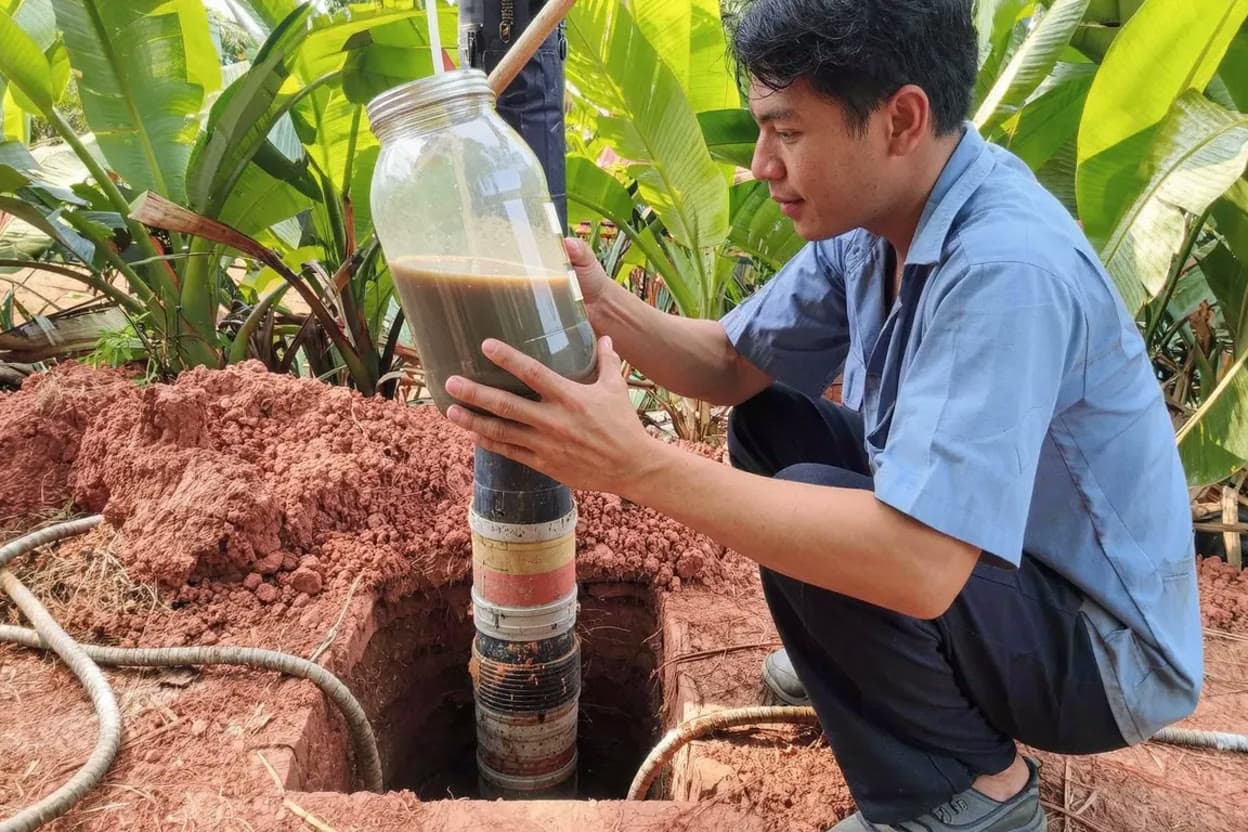
The first useful tool for cloudy well water costs nothing: a clear glass, filled and left on the counter for ten minutes. What the glass does next narrows the diagnosis more than any amount of worrying at the tap, because sand, silt, air and dissolved minerals all behave differently and come from different places in the system.
Read the glass first
- Clears from the bottom up within a minute or two: air. Thousands of tiny bubbles make water look milky, then rise and vanish. Common after pump work, and often a sign the pump is drawing air
- Grit that drops straight to the bottom: sand. Heavy, visible grains you can feel between two fingers. Sand is mechanical, and it is the finding to take most seriously
- A haze that settles over hours, or never fully: silt and clay. Far finer than sand and slow to drop, which is what most people mean by cloudy
- Water that is clear at first and colours later: dissolved minerals rather than particles, which is a different problem with a different fix
A new well is allowed to be cloudy, briefly
Drilling disturbs the ground it passes through. A properly finished well is developed afterwards, pumped and surged until the fine material around the screen is drawn out and the surrounding formation settles into a natural filter of its own. Some haze in the first days of use, tailing off steadily, is that process finishing. Cloudiness that persists for weeks, or sand that keeps arriving after the well has settled into service, is not development. It is a symptom, and the well is telling you where to look.
Where persistent sand comes from
- Incomplete development. A well rushed into service before the fines were drawn out sheds them into the house instead, for months
- A pump hung too low. Sitting near the bottom of the bore, the pump inhales the sediment that naturally accumulates there, and repositioning it is sometimes the entire fix
- Overpumping. A pump that outdraws the well's sustainable yield pulls the level down hard and drags fines through the screen with the inrushing water
- Damaged or corroded casing or screen. A split, a rusted joint or an eroded screen slot lets the formation into the bore, which is the structural end of the list
- Surface water finding a path in. Cloudiness that follows heavy rain points at the wellhead seal rather than the aquifer, and whatever the rain carries comes with it
- Disturbance after work on the well. Pulling and replacing a pump stirs up what lay quietly at the bottom; a day or two of haze afterwards is ordinary, persistence is not
Why a finer filter is not automatically the fix
Sediment filters remove sediment. They do not stop it being produced. Filtering heavy sand at the surface leaves the pump swallowing it first, and sand is what wears impellers, scores seals and shortens pump life. It also loads cartridges fast enough that the filter becomes a monthly expense and, when it clogs, the reason pressure sags and the pump starts cycling. Filtration is the right answer when the source produces fine, stable, modest sediment. It is the wrong answer when the well is eating itself.
When filtration is enough
A light, steady haze of fine silt from a well that is otherwise healthy, with stable yield and no sand, is a filtration job: a correctly sized sediment stage ahead of the rest of the treatment, with a service schedule so the stage keeps working. If the sediment level never changes and cartridges load slowly, the well and the filter have reached a fair arrangement.
When the well itself should be inspected
- Sand in any ongoing quantity, because grains mean something mechanical: the screen, the casing, the pump position or the pumping rate
- Sediment that is getting worse rather than better across weeks
- Cloudiness arriving together with falling yield, or a pump that surges and draws air
- Turbidity that follows rainfall, which points at the seal and the surface rather than the aquifer
- Any sudden change in an established well that had run clear for years
An inspection compares the well's behaviour against its original test pumping figures, checks the pump's position and condition, and where needed puts a camera down the bore to look at casing and screen directly. The findings decide the repair: redevelopment and cleaning for a fouled screen, a repositioned or resized pump, a casing repair, or a resealed wellhead. Most of those cost a fraction of the redrill that persistent sand eventually forces on a well nobody investigated.
Deep Well Samui inspects, cleans and redevelops wells across Samui, Phangan and Koh Tao. If a bore has started sending sand, or the water will not clear, the useful first step is finding out whether the answer belongs at the wellhead or in the filter room.