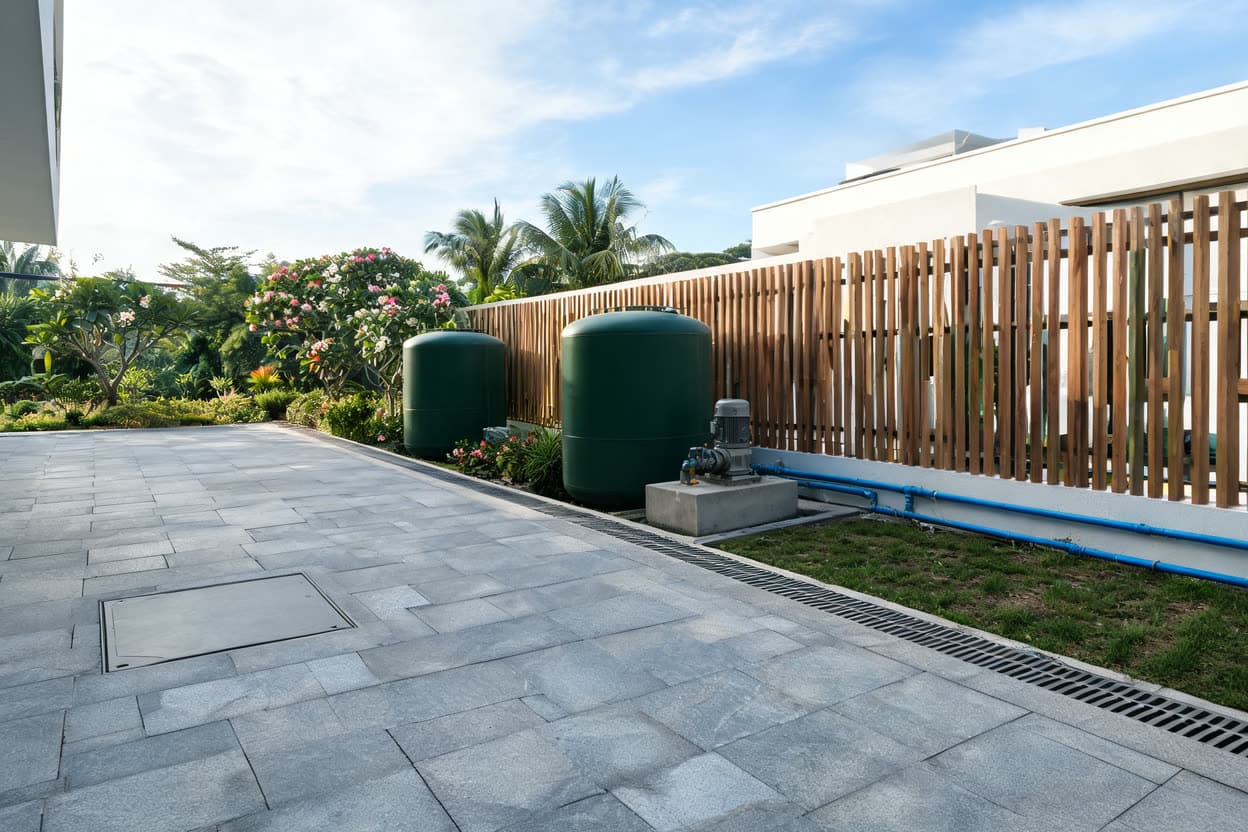
Water storage takes space, and on a villa site space is contested by the house, the pool, the garden and the view. That is why the question of where tanks go often arrives late, as a choice between leaving them visible or burying them. It is better decided early, because placement shapes access, maintenance and cost for as long as the property stands. This guide covers the physical side: where tanks sit and what that means. What they are made of and how big they should be are separate decisions.
Above-ground tanks
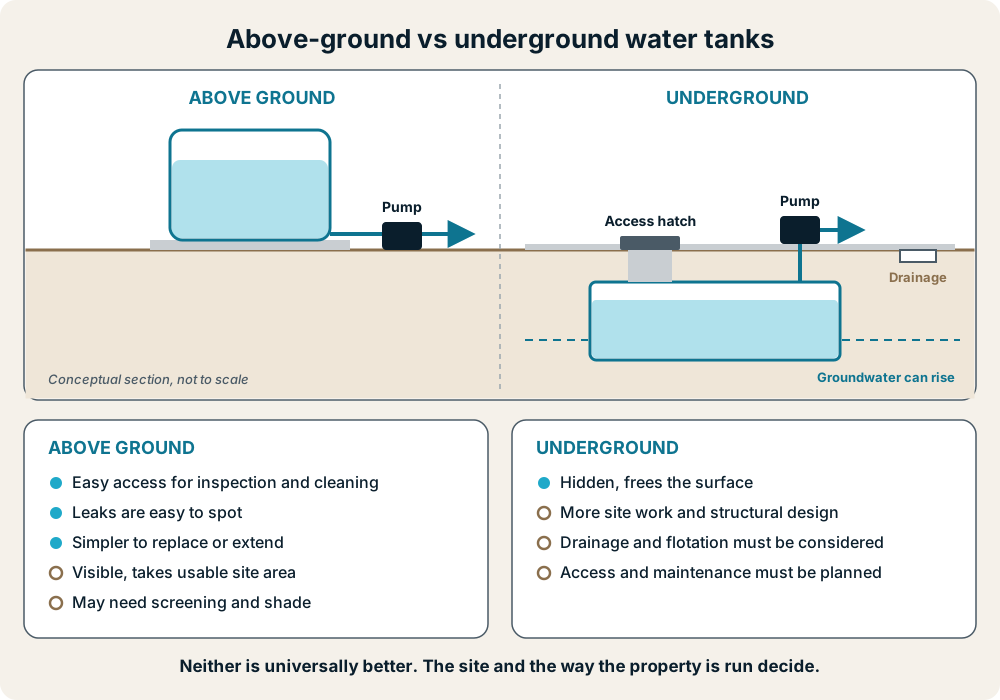
Tanks standing on a slab or a stand are the default on most island properties, for practical reasons. Everything is visible. A leak shows as a wet patch or a drip rather than a mystery on the bill. The tank can be inspected from outside, opened and cleaned without special arrangements, and replaced quickly if it fails. Pipework and valves are within reach, which makes adding a filter, a second tank or a new pump straightforward. Installation is usually simpler too: a properly designed base, the tank and the connections.
The limitations are mostly about the site. Tanks are large, and they take ground that could be garden or terrace. They are visible from the house, the pool or the neighbours unless they are screened. In full tropical sun some tank types warm the water and age faster, so shade, colour and material matter. And a tank on sloping ground needs a base designed for the ground it stands on.
Underground tanks
A buried tank disappears. The ground above it can be paved, planted or used as a terrace, which is why underground storage appeals on tight plots and on properties where the architecture is the point. Buried storage also keeps the water out of the sun.
What it asks for in return is substantial. The excavation is a construction project in its own right, and the tank and its surroundings need structural design for the actual site: the load of the soil, anything driven or built over it, and the ground conditions. Where groundwater can rise around the tank, an empty tank can be pushed upwards, and the design has to account for that. Surface water must be kept out, which on an island with heavy downpours means drainage around the tank and access hatches that sit above any water that may collect. A leak in a buried tank can run for a long time before anyone notices, and finding it is harder.
Access is the long-term issue. Cleaning and inspection mean opening a hatch and, for many tank types, entering an enclosed space, which is work with real safety requirements and should only be done by people equipped and trained for it. Water also has to be lifted out, so the pump arrangement has to suit a tank that sits below the pump. And replacing the tank itself, if it ever fails, can mean digging up whatever was built on top.
Island site factors
Several conditions on Samui, Phangan and Koh Tao push the decision one way or the other. Heavy rain makes drainage around any buried structure critical, and turns a low or poorly sealed hatch into a contamination route. Sloping plots can make a buried tank easier to build into a retaining level, or harder, depending on the ground. Difficult access limits the machinery that can reach the site, which affects both excavation and the delivery of large above-ground tanks. And many villas have very little technical space, so storage competes with pumps, treatment and electrical gear for the same corner.
Hybrid layouts
Many villas end up between the two extremes. Above-ground tanks in a technical yard behind a screen wall or planting keep full access while staying out of sight. Tanks can be set partly into a slope or a lower level so they are less visible without being fully buried. Storage can be split across several smaller tanks that fit spaces a single large one would not, with the side benefit that one can be cleaned while the others keep working. Where raw and treated water are stored separately, the two tanks do not have to share the same location or the same type of installation.
How to decide
Underground is not automatically the premium choice, and above ground is not automatically the cheap one. The right answer comes from the site and the way the property will be run:
- Site layout: how much ground is available, and where
- Access: for installation, for cleaning and for eventual replacement
- Maintenance: who will service the tanks, and how easily
- Architecture: how much the tanks' visibility actually matters
- Function: raw or treated storage, and what draws from each tank
- Cost structure: the tank plus excavation, structure, drainage and pumping
A useful test is to imagine the tank in ten years, when it needs cleaning or a fitting fails. If that work is easy to picture, the location is probably sound.
Deep Well Samui plans and installs water storage for villas and developments across Samui, Phangan and Koh Tao, above ground, below ground and in combination, alongside the well, pumps and treatment. If you are laying out a site, we can help place the storage before the landscaping makes the decision for you.