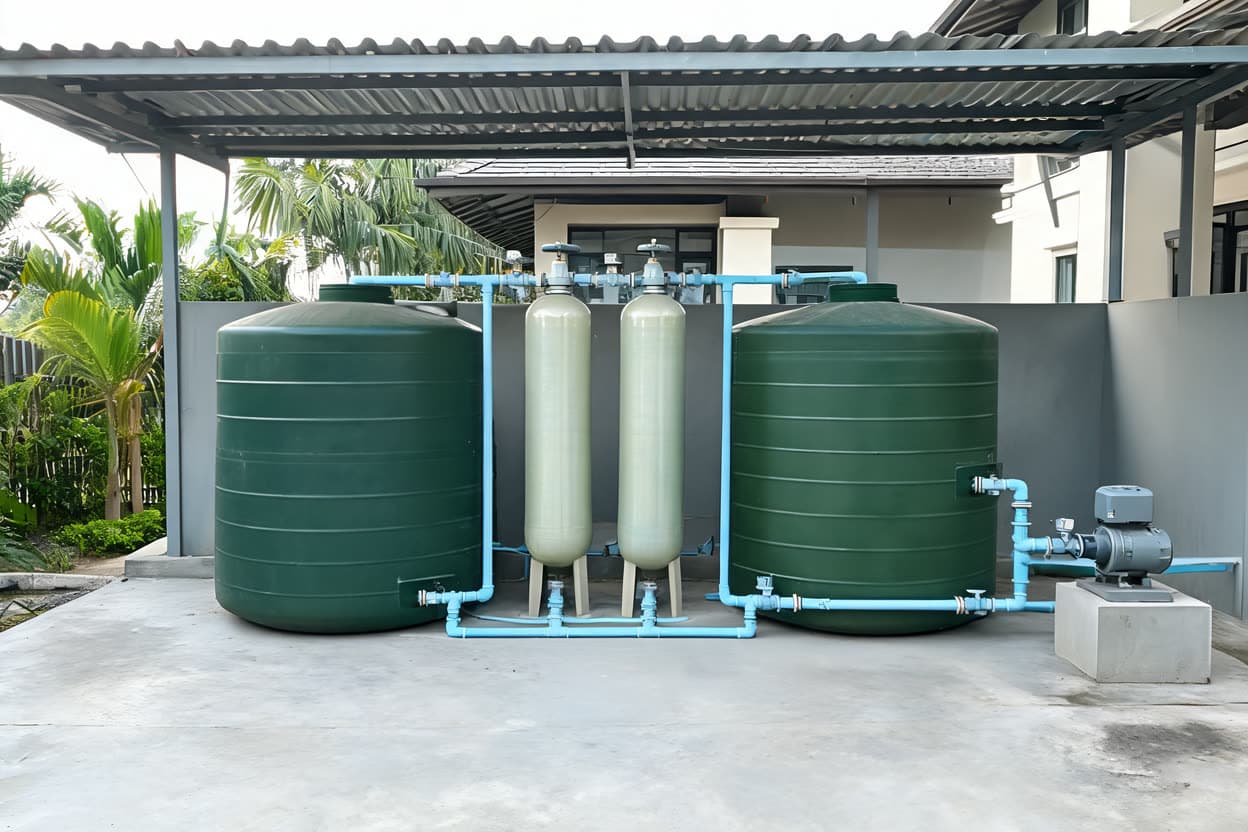
Most conversations about villa water storage are about size: how many litres, how many days of reserve. The question that comes before it is where the storage sits. A tank placed before the filtration holds raw well water. A tank placed after it holds treated water. Many systems have only one of these, and many larger or more demanding systems have both. The choice shapes how evenly the filters work, how clean the water reaching the house stays, and how easy the system is to maintain.
What each tank is for
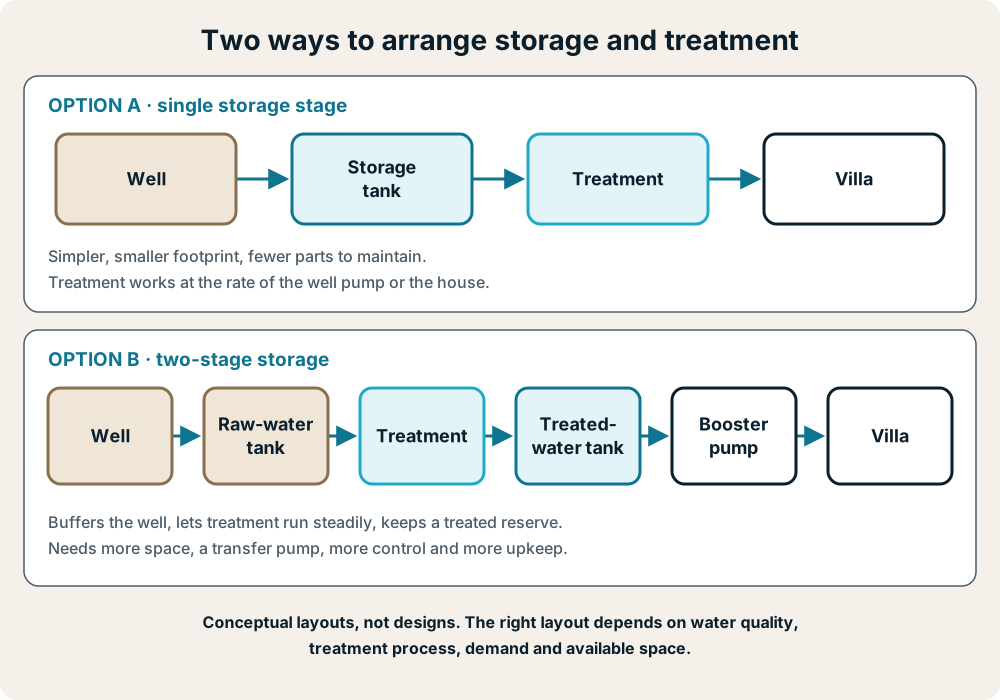
A raw-water tank sits between the well and the treatment. Its job is to decouple the well from everything downstream: the well pump fills it at the rate the well can sustain, and the treatment draws from it at the rate the treatment works best. A treated-water tank sits after the treatment. Its job is to hold water that is already clean, ready for the booster pump to deliver to the house, and to act as a reserve of treated water when demand peaks.
The single-tank arrangement
With one tank, the treatment sits either before it, so the tank holds treated water, or after it, between the tank and the house. It is simpler, uses less space, and has fewer pumps, valves and tanks to maintain. For a villa with good, consistent well water, modest treatment and reliable supply, one well-placed tank is often all that is needed.
The limitations show up under load. If the treatment sits between the well and the tank, it has to work at whatever rate the well pump delivers. If it sits between the tank and the house, it has to keep up with the house's peaks directly, and every surge in demand pulls water through the filters faster. Some treatment processes cope well with that; others work best at a steady, controlled flow.
In a single-tank layout the booster pump usually draws from the tank, and if the treatment sits after the tank, it pushes water through the filters on the way to the house. The booster then has to overcome the filters' resistance as well, and that resistance grows as the filters load up between cleanings.
Two-stage storage
With a raw-water tank and a treated-water tank, the treatment sits in the middle and can run at its own steady pace, independent of both the well and the house. The well fills the raw tank at the rate it can sustain. A transfer pump moves water through the treatment into the treated tank. The booster pump then supplies the house from clean water only. That separation helps in several ways:
- The well is buffered, so a modest yield can still meet peak demand
- Filtration runs at a steady flow, which suits many treatment processes and makes their performance more consistent
- A reserve of treated water carries the house through filter backwashing, servicing or a short treatment fault
- Either tank can be drained and cleaned while the other keeps the system running
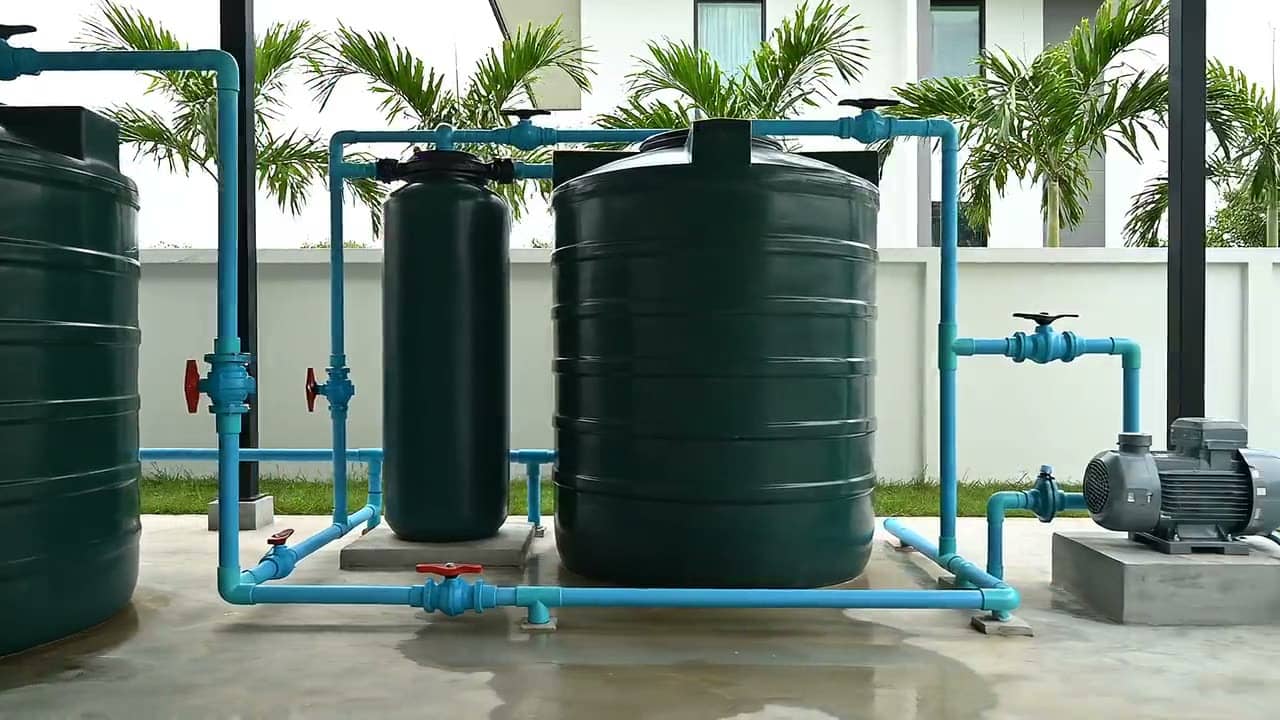
The costs are real too. Two tanks need more space, more pipework, an extra pump and more control. The water in each tank has to turn over regularly so it does not stand too long, which matters more for the treated tank. And there are more components that need maintenance. For a small house with straightforward water, those costs may buy little.
What decides the layout
The right arrangement comes from the specific property rather than a preference. The water quality and the treatment process matter most: some treatment needs steady flow or contact time, which favours two stages. The well's yield and reliability decide how much buffering the source needs. Peak demand, occupancy, irrigation and pool make-up decide how hard the system is pushed at its busiest. And the available space in the technical area decides what is physically possible.
Irrigation deserves a specific mention. Garden water rarely needs the same treatment as drinking and shower water, so some systems draw irrigation from the raw-water tank and send only household water through the full treatment. That can reduce the load on the filters considerably.
Signs the current layout is not working
Existing systems often show when storage and treatment are in the wrong order. None of these proves the layout is the cause, but each is worth raising during an inspection:
- Water quality at the taps varies with how much water the house is using
- Filters clog or need backwashing far more often during busy periods
- Pressure drops sharply whenever the filters are backwashing
- The well pump starts and stops frequently to keep up with the house
- There is no clean water at all while the treatment is being serviced
Some of these have other causes, from undersized equipment to filter media at the end of its life, which is why the fix starts with a look at the whole sequence rather than a new filter.
Deep Well Samui designs and installs storage and treatment layouts for villas and resorts across Samui, Phangan and Koh Tao, from single-tank systems to two-stage storage with transfer and booster pumps. If you are planning a technical area or your filters struggle to keep up, we can recommend the arrangement that fits the water and the property.