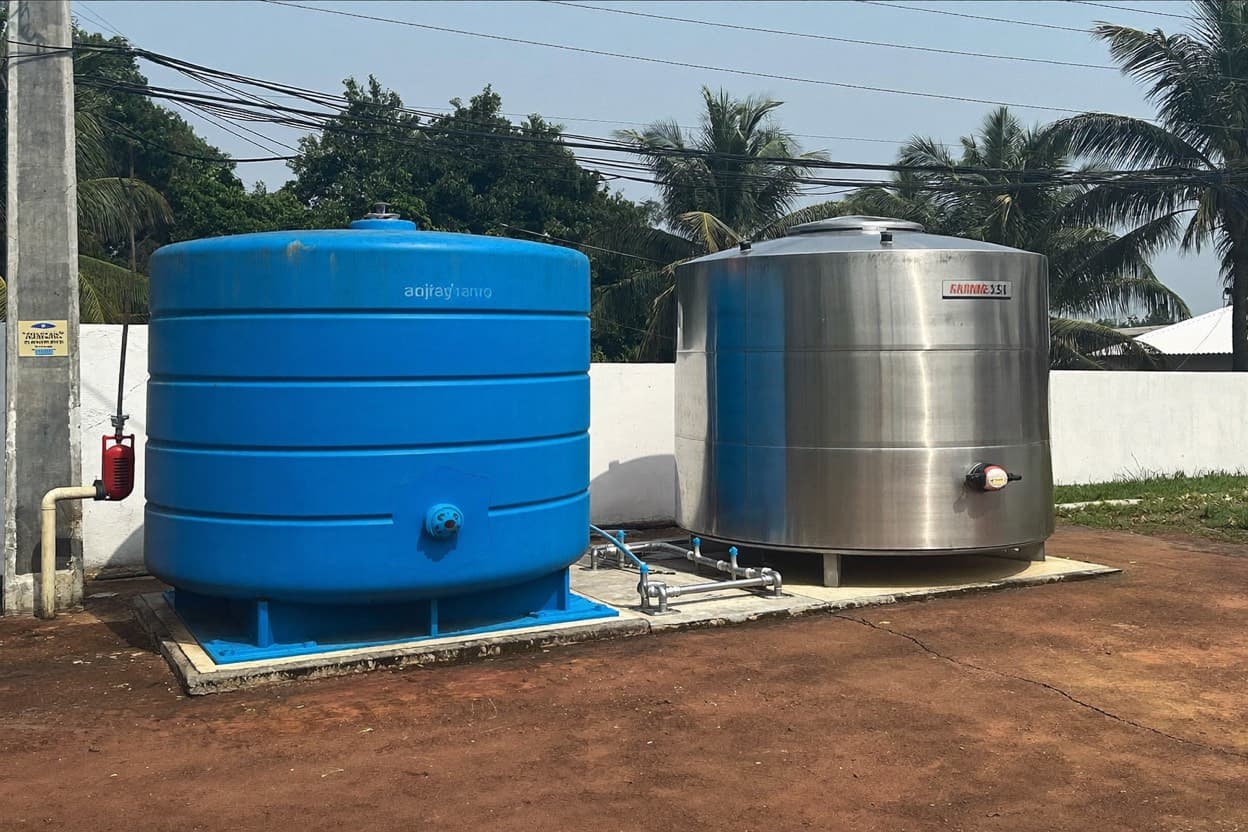
Once a villa knows how much storage it needs, the next question is what that storage should be made of. On the islands this is not a cosmetic choice. Tropical sun, salt air near the coast, groundwater chemistry and the practicalities of cleaning all treat the four common materials differently, and the right answer depends on where the tank sits and what water it holds.
Polyethylene: the default for a reason
The blue PE tank is the workhorse of Thai water systems. It is light enough to move without machinery, tolerant of being plumbed and re-plumbed, resistant to the corrosion that coastal air inflicts on metal, and available in sizes from a garden barrel to serious villa storage. Quality varies more than buyers expect: thicker multi-layer walls with a dark inner layer resist sunlight and algae far better than thin bargain tanks, and on an island the tank usually lives outdoors in exactly that sunlight.
The honest weaknesses are heat and permanence. PE softens its shape over years of tropical sun when under-specified, and a badly damaged tank is replaced rather than repaired. Neither matters much when the tank is shaded, correctly rated and honestly sized.
Stainless steel: durable, visible, fussy about water
Stainless tanks age gracefully, stay rigid, and look at home beside a modern villa, which is why they often win where the tank cannot be hidden. Two caveats matter locally. Salt-heavy coastal air is hard on cheaper grades, so the steel specification matters within sight of the sea. And chlorinated or aggressive water is harder on welds than owners assume, so what the tank will actually hold belongs in the decision, not just how it looks.
Fibreglass: the large-volume specialist
Sectional fibreglass panels assemble into volumes that single moulded tanks cannot reach, which makes them the practical answer for resorts, developments and rooftop tank farms. They are repairable panel by panel and light for their capacity. The trade-off is that panel joints and internal frames add inspection points, and assembly quality decides whether a panel tank is excellent or a slow leak. This is a material you buy together with the installer's track record.
Concrete: the permanent option
Cast or block-built tanks, usually underground, hold large volumes invisibly and keep water pleasantly cool. They demand real structural design, waterproofing that is done properly once, and access for cleaning that is planned before the first pour. Cracks are repairable but never convenient. Concrete suits projects planned around it from the start far better than retrofits.
The comparisons that actually decide it
- Sunlight: opaque walls beat translucent ones everywhere on the islands; algae loves a thin bright tank
- Water contact: raw well water, treated water and pool make-up water age materials differently
- Cleaning: whatever the material, a tank nobody can open and reach into will not be cleaned
- Placement: rooftop weight, coastal air and visibility each remove options from the list
- Repair: panels and concrete can be fixed in place; a failed moulded tank is a replacement
Material choice is the second half of a storage decision that starts with volume and placement, and it interacts with the rest of the system: what the treatment stage needs, where the pressure pump draws from, what the structure can carry. Deep Well Samui supplies and installs storage as part of complete water systems across the islands, and a site visit settles material, size and placement in one conversation.