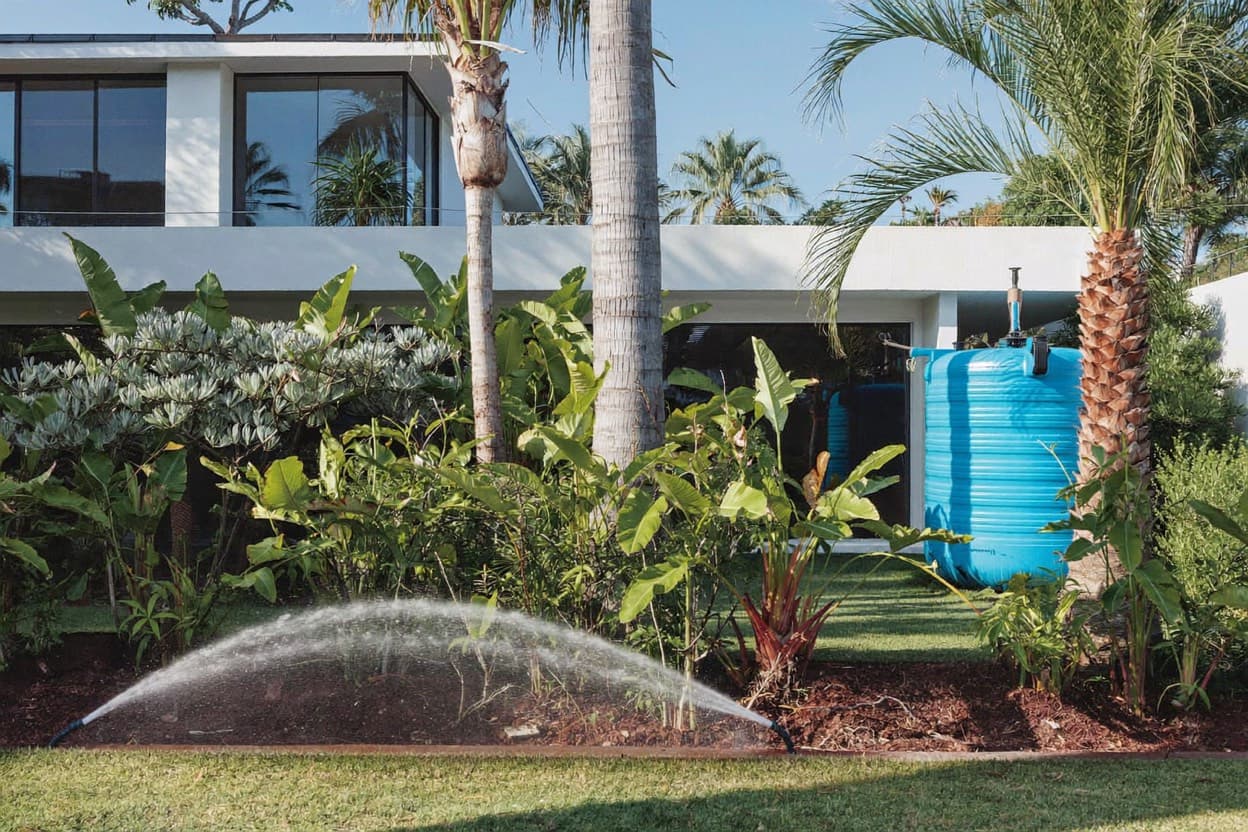
Owners plan wells around bathrooms and forget the garden, then discover that the garden is the biggest consumer on the property. A few irrigation zones running through the dry season can move more water than the whole household, and unlike the household, the garden drinks most exactly when the ground has least to give. A deep well can absolutely carry serious landscaping on Samui. It just has to be designed as an irrigation source, not assumed to be one.
Irrigation demand is a different shape
Domestic use trickles through the day. Irrigation slams: each zone wants a substantial, steady flow for a set run time, usually in the early morning or evening when evaporation is lowest, and then wants nothing at all. So two numbers describe the job. The flow a zone needs while running, which decides pipes and the pump. And the total volume a full watering cycle consumes, which decides what the well and storage must supply per day. Confusing the two is where most home-built irrigation goes wrong.
The well does not have to match the sprinklers
The most useful idea in irrigation design is that the well's production rate and the garden's consumption rate never need to meet directly. A storage tank sits between them: the borehole refills it steadily all day at whatever rate the ground sustains, and the irrigation pump draws hard from it for an hour at dusk. A well that could never feed six sprinkler zones directly can fill a tank that feeds them easily, one zone at a time.
That decoupling is also what protects the well itself. Forcing a borehole to serve peak irrigation flow directly invites the classic oversized-pump problems: drawdown below safe level, dry-run trips, a pump cycling itself to death. The tank absorbs the violence of irrigation demand so the well never feels it.
Zones are the designer's volume control
Splitting a garden into zones does more than organise the pipework. Each additional zone lowers the instantaneous flow the system needs, because zones run one after another instead of together. A garden that would demand an industrial pump as one zone becomes comfortable for a modest pump as six, at the cost of a longer total watering window. Zone count, run times, pump size and tank volume are one calculation, and horsepower alone predicts none of it.
Water quality still matters, even for plants
Plants are undemanding, but irrigation hardware is not. Sediment wears pump impellers and blocks drip emitters and spray nozzles, so raw well water usually earns at least simple sediment filtration ahead of the irrigation lines. Iron-rich water adds a cosmetic problem: it feeds brown staining on pale walls, paving and stonework wherever spray lands. A basic water test tells you whether the garden circuit needs its own light treatment, separate from whatever the house requires.
Dry season is the design case
Everything above gets decided by the worst month, not the average one. In the dry months irrigation demand peaks, groundwater levels sit at their lowest, and a design that only works in the wet season fails exactly when the garden is most expensive to lose. Sizing storage with dry-season reserve in mind, and scheduling irrigation into the cool hours, are the difference between a garden that survives March and one that defines it.
Deep Well Samui designs and installs complete well, storage and irrigation supply systems for villas, resorts and landscaped properties across Samui, Phangan and Koh Tao. If a garden is being planned or an existing one keeps outrunning its water, the yield figures and a site visit are where the design starts.