On a quiet island morning, a villa and a small resort look like the same water customer. Then high season arrives. The villa's demand roughly doubles. The resort's demand triples, concentrates into two sharp peaks a day, and acquires a property it never had before: every failure now has a review attached. For a hotel, water is not a utility humming behind the scenes. It is part of the product guests are paying for.
That changes how a groundwater system should be designed. The hardware is familiar, a drilled well, storage, pumps and treatment, but the sizing logic, the redundancy and the installation constraints are all different at hotel scale. This guide covers what actually moves.
Occupancy sets the design, not the average
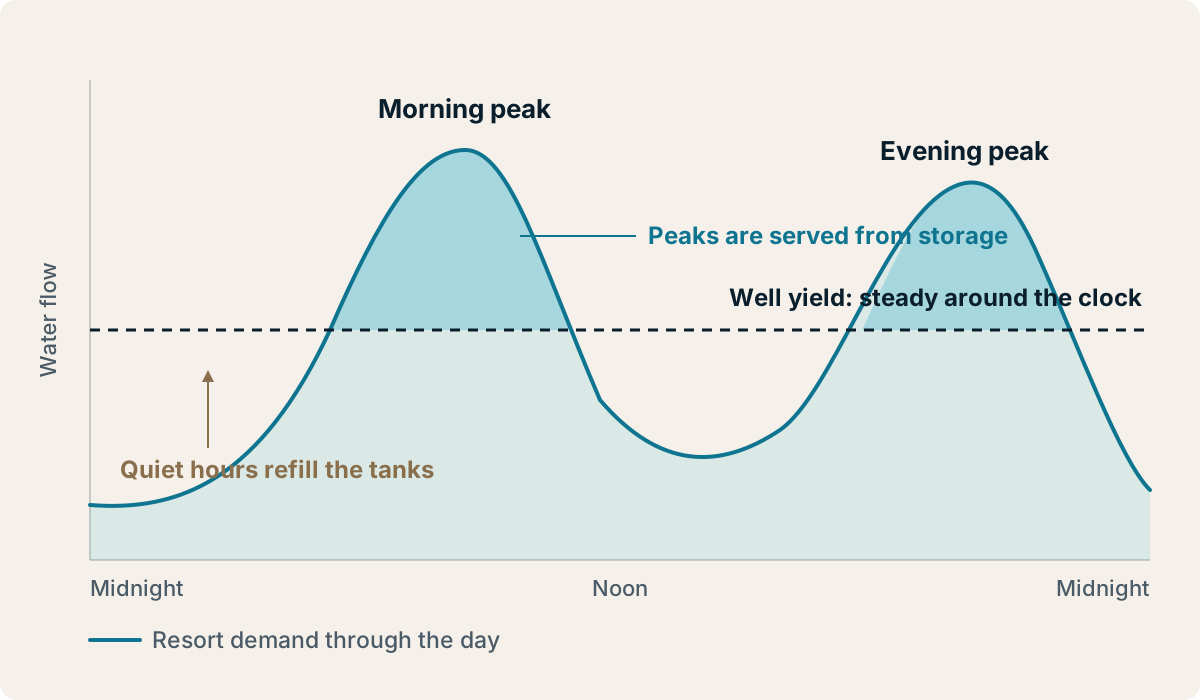
Annual water consumption divided by 365 produces a number that will sink a resort. The system has to be designed for the fullest morning of the driest month: every room occupied, every guest showering between seven and nine, laundry running since breakfast, the pool calling for top-up after a windy night. Averages smooth away exactly the peaks the design exists to survive.
It helps to list what a hotel adds that a villa never carries at scale:
- Laundry, usually the largest hidden consumer, and it runs every single day of high season
- Kitchens and dishwashing, with rinse volumes set by hygiene standards rather than habit
- Pool and spa top-up, plus the water the filter backwash quietly takes
- Staff quarters, which behave like a second small hotel behind the first
- Grounds irrigation, which peaks in exactly the months the well is slowest
Each of these is modest on its own. Stacked into the same two-hour window, they define the peak the pumps and pipes must carry, and the daily total the source must replace before the next morning does it again.
A well is a rate; storage turns it into capacity
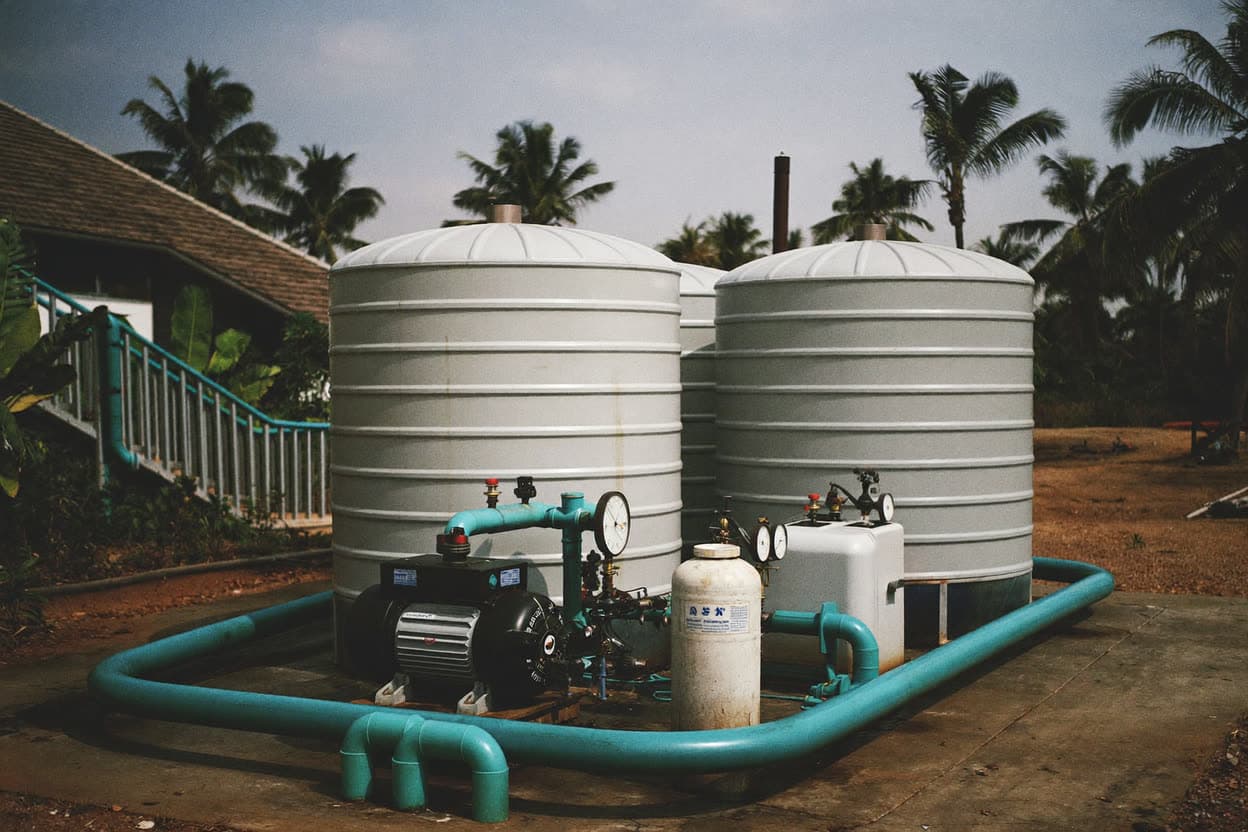
A drilled well produces at its tested rate, so many cubic metres per day, spread evenly around the clock. A resort consumes in bursts. The two profiles are incompatible without a buffer in between, and that buffer is storage. The well refills the tanks quietly for 24 hours; the tanks absorb the two daily assaults; transfer and booster pumps turn stored volume into steady pressure at every outlet at once.
At hotel scale the storage itself usually splits in two: a raw-water bank fed by the well, and a treated bank feeding the buildings, with filtration working at its own calm pace between them. Splitting the banks also splits the risk, since a treatment fault no longer empties the whole reserve.
Redundancy is what you are really buying
A villa that loses its pump for a day has an uncomfortable story. A full resort has refunds. Hotel-grade design assumes components will fail and arranges for guests never to find out: duty and standby transfer pumps rather than a single unit, and a second source where the site allows it, whether that is a second bore, a municipal connection held as backup, or a standing delivery arrangement that activates with one phone call. Level sensors and a simple alarm turn a quiet overnight failure into a maintenance ticket instead of a dry breakfast service.
Retrofitting a resort that is already running
Most resort projects are not blank sites. The property already operates, the plant room is full, and nothing may interrupt guests. The workable pattern is phased: drill and test the well in low season, build the new storage and treatment alongside the old supply, switch over building by building, and keep the previous source connected as the standby it should always have been. Done in that order, the guests' only clue is that the water bills changed.
Deep Well Samui designs, drills and maintains water systems for resorts and hotels across Samui, Phangan and Koh Tao, covering the first feasibility survey as well as the scheduled care of the finished plant. If your property is outgrowing its supply, the survey that starts the conversation is free.