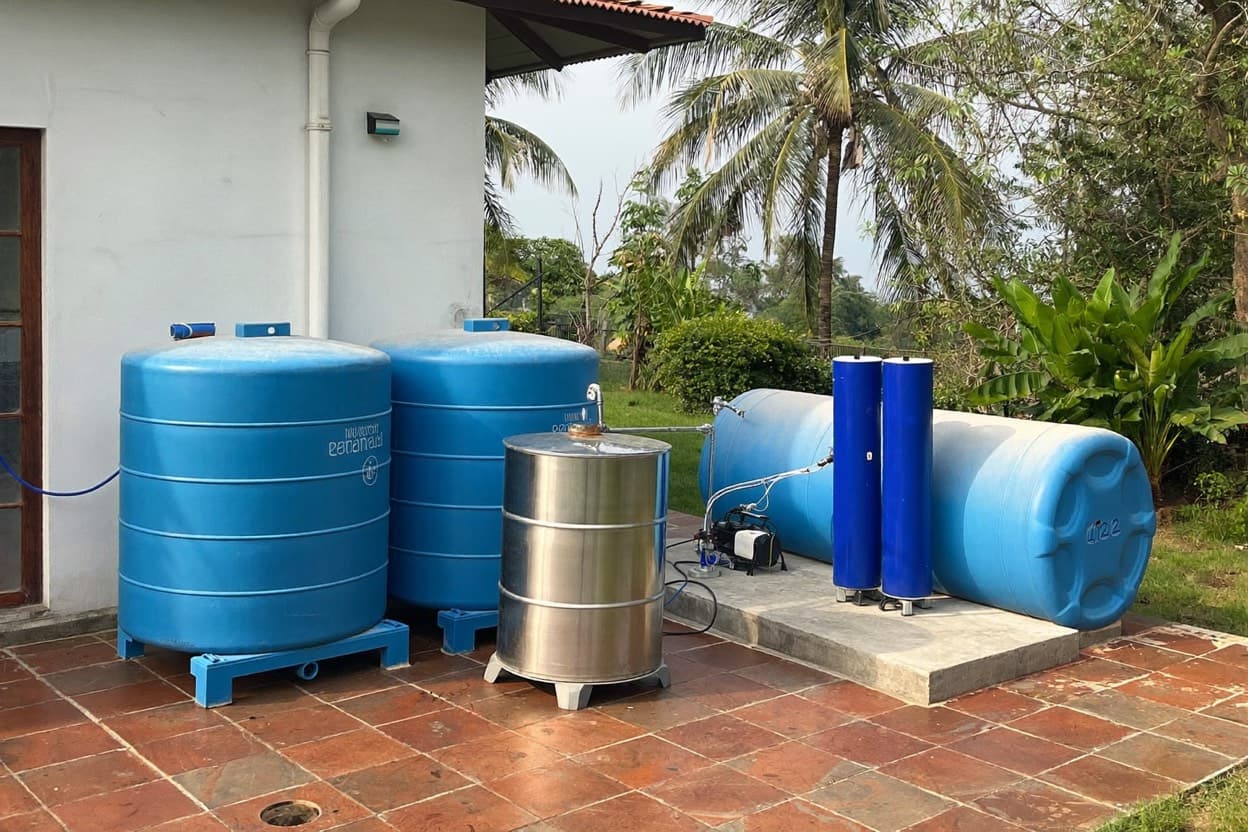
Owners usually meet their water system one component at a time. A pump fails, a tank runs dry in April, a filter starts letting sediment through, and each event looks like its own problem. It rarely is. A villa water system is a chain of four stages, and most of the faults we get called to are one stage quietly working against another.
This is the whole chain in one place: what each stage does, how they are sized against each other, and where the money tends to be wasted.
The chain: source, storage, pressure, treatment
Water arrives from a source, rests in storage, is pushed to the taps at a controlled pressure, and is treated somewhere along the way to the standard the property needs. Four stages, in that order, whether the property is a two bedroom house or a twelve villa estate. What changes with scale is the size of each stage, never the shape of the chain.
The design rule that follows is simple and routinely ignored: each stage is sized against the one before it. A pump chosen without knowing what the well sustains, or a filter set bought without a water test, is a guess bolted onto the chain.
The source sets the ceiling
On the islands the source is a borehole, a municipal or village connection, delivered water, or some combination. Whichever it is, its reliable rate of supply is the ceiling the rest of the system lives under. No pump or tank arrangement can hand the property more water than the source provides over a day.
A private well is the source that pays for itself where demand is steady and the alternative is trucked top ups: pools, irrigated gardens, multiple bathrooms, guests through the dry months. What a given plot can support is a survey question, not a brochure question.
Storage does the balancing
Every source delivers steadily; every villa consumes in bursts. Morning showers, evening irrigation, a pool top up, all landing inside a few hours. Tanks sit between those two rhythms and absorb the mismatch, which is why storage is sized from the property's real daily pattern rather than from what fits behind the pump house.
On an island, storage is also the reserve that carries the property through an interruption: a supply cut, a pump waiting for a part, a delivery truck that cannot reach the soi that day. How many days the property should be able to stand on its own is a decision an owner makes once, and the tank volume follows from it.
Pressure is made, not found
Tap pressure on most island properties is produced on site. Water falls from the tank into a pump that raises it to the pressure the house runs at, held steady by a pressure vessel or an inverter driven constant pressure unit. When a shower runs weak, this is the stage everyone blames, and it is guilty less than half the time. A clogged filter ahead of the pump, or a tank the source keeps leaving empty, produces exactly the same symptom.
Hillside properties add elevation to the calculation. Pushing water up to an upper court or a high tank costs pressure that the pump has to produce on top of what the taps need, and the arithmetic is unforgiving enough that pressure problems on slopes deserve their own article.
Treatment is sized to a test
Island groundwater commonly carries hardness, iron and manganese, at levels that change bore to bore. Delivered water has a source too, and it varies with it. So treatment is the one stage that cannot be specified from experience alone: it is sized to a water test, stage by stage, sediment ahead of media, media ahead of any drinking water polish.
Filtration is also the stage that degrades silently. Media exhausts, cartridges load up, and the water keeps flowing while the treatment quietly stops happening. Whatever is installed, the service schedule is part of the system, not an accessory to it.
Where villa systems usually go wrong
- A pump bought for the house without asking what the well sustains, so it outdraws the source and cycles itself to an early death
- Storage sized to the space available rather than the demand, leaving no real reserve for the dry season
- Treatment installed once and never serviced, protecting nothing after the first year
- Each stage installed by a different contractor, so no one owns the chain and every fault becomes a debate
Designed once, it stays boring
A system designed as a chain is unremarkable to live with. The tank covers the peaks, the pump never chases a demand it cannot meet, the filters see a technician on schedule, and the water is simply there, at pressure, every month of the year. That is the whole ambition, and it is entirely achievable on any of the islands.
If a villa, renovation or small resort on Samui, Phangan or Koh Tao needs its water thought through as one system rather than four purchases, Deep Well Samui designs, installs and services the complete chain, from the borehole to the last tap.