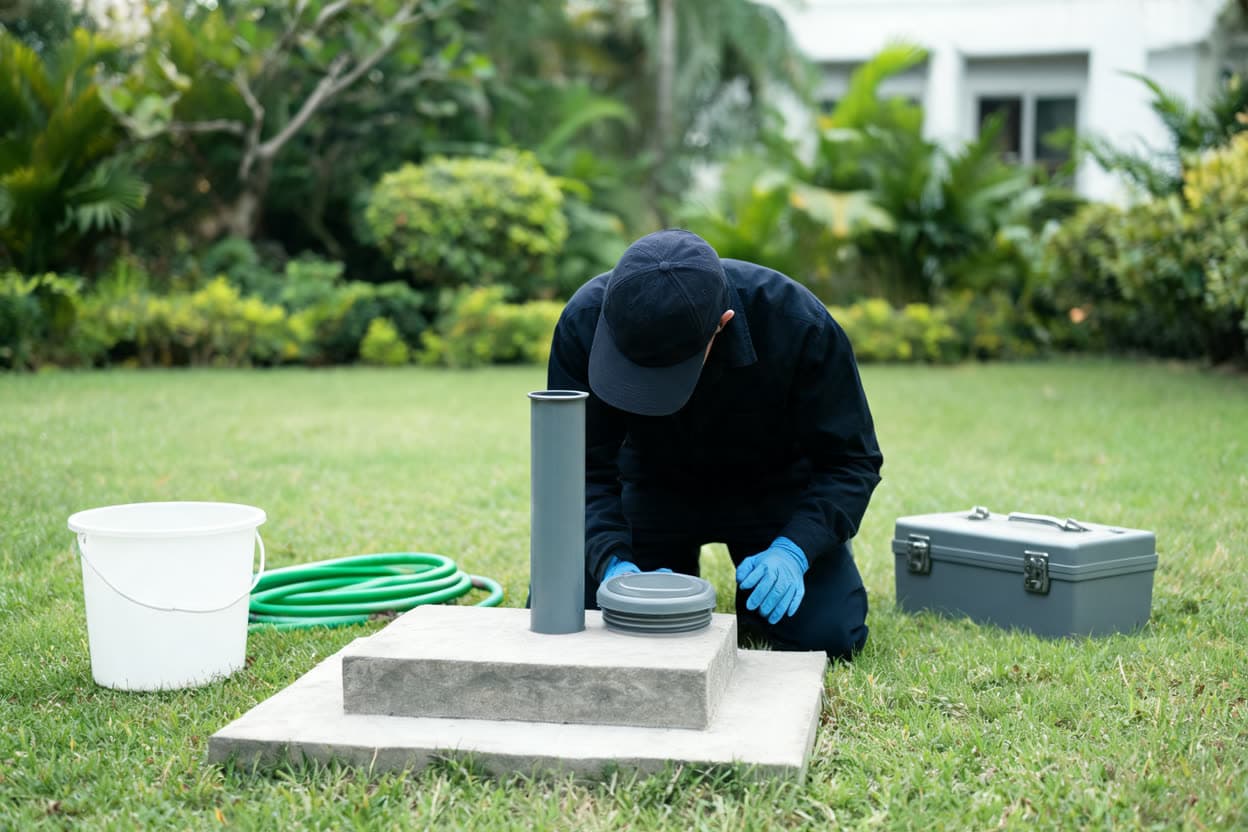
Most of the time a well with a sound casing and a protected wellhead needs nothing more than routine servicing. Then something happens. Floodwater rises over the wellhead after a storm. The pump is pulled out, laid on the ground and lowered back in. The house stands empty through a long low season. Each of these can introduce bacteria and organic material into the borehole, and none of them is solved by a filter on the house supply.
Disinfection treats the well itself: the water standing in the casing, the inside of the casing and the equipment hanging in it. It is a one-off corrective step after an event, not something that runs every day, and it is only one part of the job. Done on its own, without the steps around it, it gives a false sense of security.
What actually gets into a well
Floodwater is the obvious route. It carries whatever was on the surface, from garden soil to drainage and septic overflow, and if it covers an unsealed or low wellhead it goes straight down the casing. Pump work is the less obvious one. A pump, riser and cable that spent an hour on the lawn come back with soil and whatever lives in it. Tools, buckets and hands touch the inside of the casing. A cap left off overnight lets in insects and debris.
Disuse is different again. Water that stands for months in a well and its pipework can develop a growth of bacteria and slime, even when nothing has entered from outside, and the first water drawn after a long break often smells or tastes stale. A new or rehabilitated well also belongs on this list, since drilling and redevelopment introduce equipment and surface water by their nature.
Disinfection is not filtration, and not routine dosing
These three are easy to confuse because they can all involve chlorine or similar treatment. Filtration removes particles and, depending on the media, dissolved iron, manganese or hardness from water as it flows to the house. Continuous disinfection, such as UV or dosing on the drinking line, treats water every day as a permanent part of the system. Well disinfection is a single treatment of the borehole after an event, followed by flushing, so that the well goes back to supplying water that does not need emergency treatment downstream.
The distinction matters because the wrong one is often bought. A household that adds a stronger filter after a flood is treating the symptom while the source stays contaminated, and a UV unit asked to cope with a heavily contaminated well is being asked to do a job it was never sized for.
The sequence that works
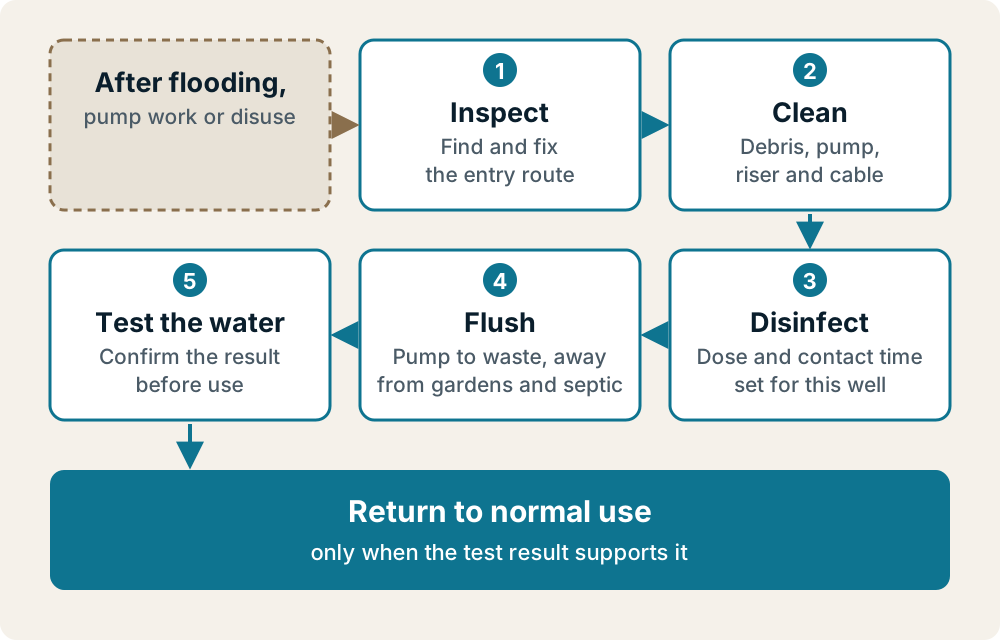
- Inspect first: find out how contamination got in, check the wellhead, casing top, cap and penetrations, and fix the cause before treating the effect
- Clean where needed: remove debris and sediment, and clean the pump, riser and cable before they go back into the well
- Disinfect: treat the water in the well and the inside of the casing, with a concentration and contact time chosen for that well's volume and condition
- Flush: pump the treated water to waste, away from gardens, ponds and the septic system, until the disinfectant has cleared
- Test: have the water tested after flushing, rather than assuming the treatment worked
- Return to normal use only when the result supports it
The concentration and contact time are deliberately not given here as a rule. They depend on the volume of water in the well, the depth, the casing and pump materials, and what the contamination was, and a dose that is too weak achieves nothing while one that is too strong can damage equipment and take a long time to flush. They should be set for the specific well by whoever carries out the work.
Why the test at the end matters
A treated well can still fail. The contamination may have reached further into the surrounding ground than the treatment reached, the cause may not have been fixed, or the flush may not have been complete. A water test after flushing is the only evidence that the well is back to normal, and keeping that result with the well's documents gives a baseline for the next time something happens.
When to leave it to a technician
Disinfecting a well means handling concentrated chemicals, opening the wellhead and often pulling the pump, which involves electrical isolation and lifting heavy equipment out of a deep bore. A technician also brings the parts a homeowner usually cannot do alone: finding the entry route, cleaning the pump properly and arranging the follow-up test. Professional handling is the safer choice after flooding, after any work that involved pulling the pump, when the water smells or looks wrong, and whenever the well supplies drinking water to guests.
Deep Well Samui inspects, disinfects and services wells across Samui, Phangan and Koh Tao after floods, pump replacements and long periods of disuse, and arranges the water test that confirms the result. If your well has been through any of these, one visit sets out what it needs.