A submersible pump is built to live underwater. The water it moves also cools its motor and lubricates its bearings, so a pump that keeps running after the water around it is gone overheats and wears fast. Dry-run protection exists to catch that moment and stop the motor. On an island well it is one of the cheapest pieces of insurance in the whole system, and one of the most misunderstood when it trips.
The common reaction to a dry-run alarm is to assume the well has run out of water. Sometimes it has. Often something else is going on, and the protection is doing exactly its job by flagging it.
What dry running actually means
A pump runs dry when its intake is no longer surrounded by enough water. In a borehole that usually happens because the water level falls while pumping, down toward or below the pump, so the intake starts drawing air. It can also happen when water reaches the pump but cannot leave it, because a valve is closed or a pipe is blocked, and the water trapped inside heats up with no flow carrying the heat away. Either way the motor loses the cooling it depends on.
How protection detects it
There is no single standard method. Installations use one or more of these approaches, depending on the pump, the controller and how the system was designed:
- Level electrodes: probes hung in the well detect whether water is present at a set depth; the pump stops when the water falls below the lower probe and is allowed to restart once it recovers
- Current or power monitoring: a pump moving water draws a characteristic load, and a pump drawing air draws noticeably less; the controller trips when the load falls below the expected level
- Controller-based detection: many modern pump drives and controllers watch power, speed and other running data and stop the pump when the pattern points to dry running
- Pressure or flow logic: if pressure does not build or no flow is detected within a set time after starting, the controller stops the pump
- Float or level switches: common in storage tanks to protect a booster pump from an empty tank, but rarely practical inside a narrow borehole
Each method has its own blind spots. Electrodes need to be at the right depth and kept clean. Load-based detection has to be set to the actual pump, because the difference between pumping water and pumping air varies from one installation to another. That is why the settings belong to the person who commissions the system, not to a guess.
Why the alarm does not prove the well is empty
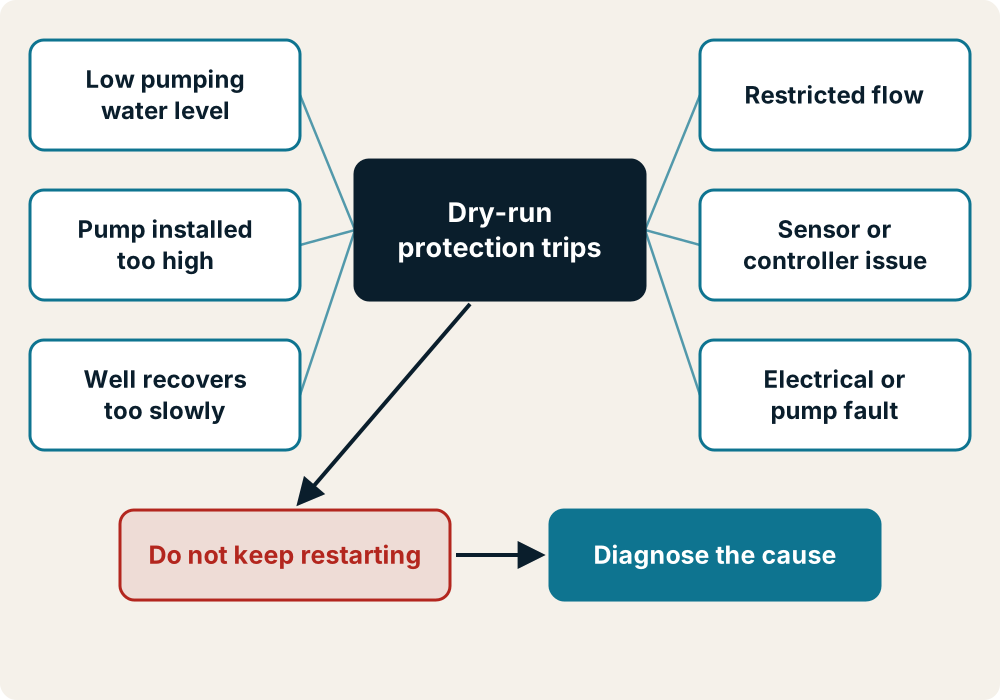
A trip means the protection saw the condition it was set to detect. Several quite different faults produce that condition. The water may genuinely have fallen below a safe level because the well recovers more slowly than the pump draws. The pump may simply be set too high for the dry season. A closed valve, a blocked filter or a failing check valve can restrict flow so the pump works against itself and its load drops, which load-based protection reads as dry running. A dirty electrode, a damaged probe cable or a controller setting that does not match the pump can trip on a perfectly wet well. And an electrical problem or a worn pump can change the running load enough to look like the same thing.
What to check before blaming the well
The pattern of the trips says a lot. A pump that runs normally for a while and trips toward the end of long runs, especially late in the dry season, points toward the water level and the well's recovery. A pump that trips within moments of every start points more toward a valve, a blockage, a sensor or the controller. A sudden change after a power cut or recent work suggests settings or wiring. The next step is a measurement: the water level in the well while the pump is running tells you directly whether the pump still has water above it.
Automatic reset, manual reset, and why forcing it fails
Controllers handle a trip in different ways. Some restart automatically after a delay, giving the well time to recover before trying again. Some require a manual reset. Many allow a set number of automatic attempts and then lock out until someone investigates. The right behaviour depends on the cause: an automatic restart suits a well that occasionally draws down at peak demand, while a lockout is the correct response to repeated trips that point to a real fault.
What does not work is resetting the pump over and over, or disabling the protection to keep water flowing. Each forced restart into a dry or blocked well heats the motor again, and a pump that keeps tripping is warning about a problem that will not go away by itself. If the well genuinely cannot keep up, the real fixes are a lower pumping rate, more storage so the pump can run gently, or a deeper setting where the well allows it. If it is a valve, a filter or a sensor, those are cheap to fix once found.
Deep Well Samui diagnoses dry-run trips across Samui, Phangan and Koh Tao, measuring water levels, checking valves, sensors and controller settings, and resetting pumps to a depth and duty the well can sustain. If your pump keeps stopping on a dry-run alarm, we can find out which of the causes it is.