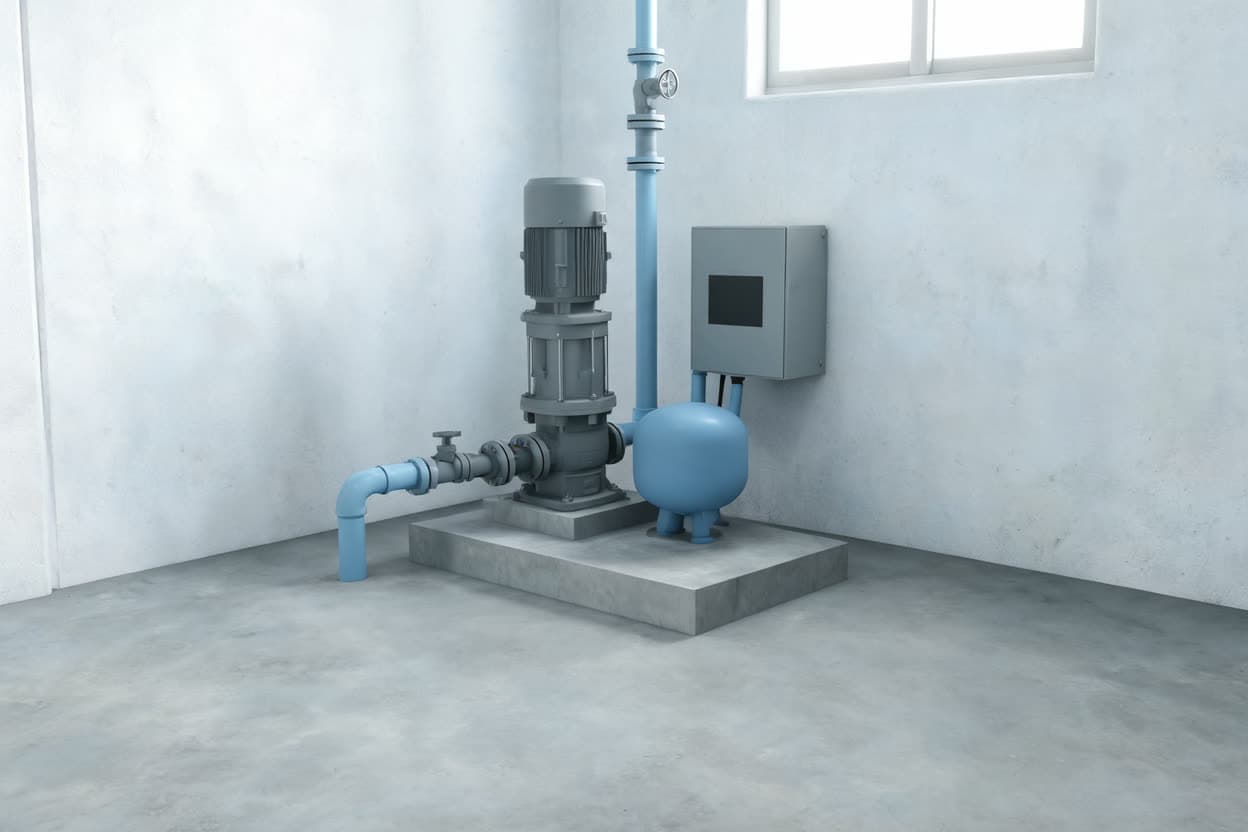
In most island villas the water does not reach the taps straight from the well. The well pump fills a storage tank, and a booster pump takes water from that tank and pressurises the house. The booster is the pump the household actually feels: it decides whether a shower stays steady when someone opens the kitchen tap, and whether the pressure surges and sags as the pump switches on and off.
How a fixed-speed booster behaves
A conventional booster runs at one speed. A pressure switch starts it when pressure falls to a lower setting and stops it when pressure reaches an upper setting, and a pressure vessel stores a little water under pressure so the pump does not start every time a tap opens. The result is pressure that moves within a band: it drops while the pump is off and the vessel empties, then rises when the pump starts. For many homes that band is perfectly acceptable, and the system is simple, robust and easy to repair.
What variable speed changes
A variable-speed booster, often called an inverter or constant-pressure pump, adds a pressure sensor and a drive that controls the motor speed. Instead of switching between off and full speed, the controller speeds the pump up or slows it down to hold the pressure close to a set target. One shower running needs little flow, so the pump turns slowly. Three bathrooms, a washing machine filling and the garden irrigation all at once need far more, so it speeds up. When demand stops, the controller confirms there is no flow and stops the pump.
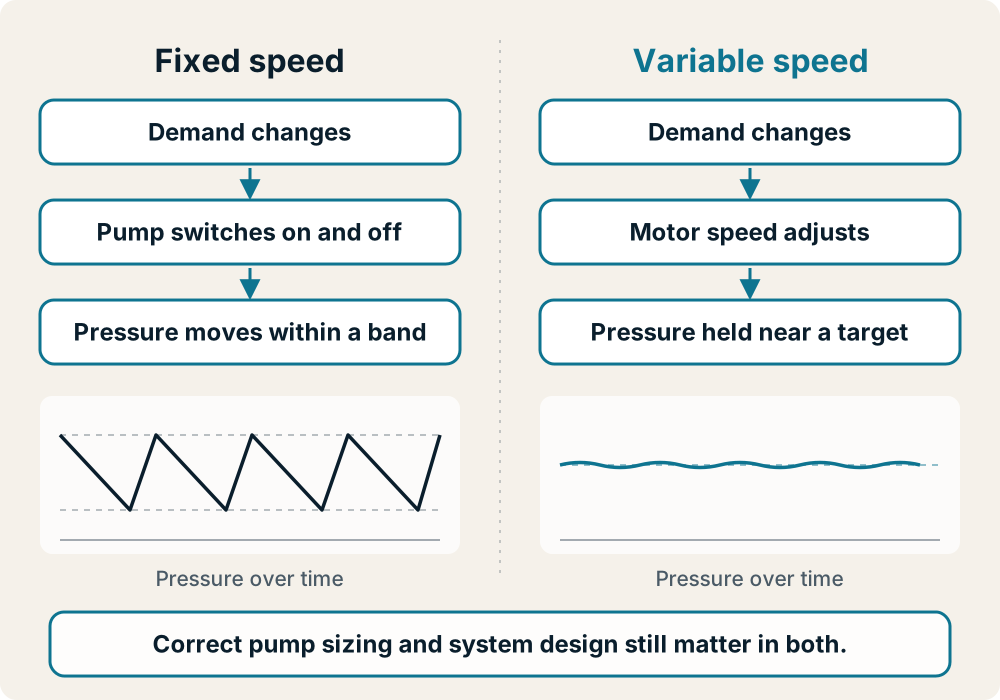
The practical benefits follow from that. Pressure stays steadier when several outlets are used together, which matters in a rental villa where guests do not coordinate their showers. Starts are soft instead of abrupt, which is easier on the motor and the pipework. The pump cycles far less, and the system needs only a small pressure vessel rather than relying on a large one to limit starts.
Energy savings depend on how the house uses water
Variable speed is often sold on energy savings, and the honest answer is that they depend on the system. A pump running slowly at low demand can use much less power than a fixed-speed pump at full speed, so a house with long periods of light, varied demand can save meaningfully. But a constant-pressure system still has to produce the target pressure even at very low flows, and where the required pressure is high relative to the flow, the savings shrink. The demand profile, the head, the operating hours and how well the pump is matched to the duty all decide the result, so a percentage figure quoted without knowing the house means little.
What it cannot fix, and what it needs
A variable-speed controller controls a pump. It cannot correct undersized pipes, a storage tank that runs dry, a pump that is wrong for the duty, or a distribution layout that starves the far end of the house. If those problems exist, a smarter pump will only make them more expensive.
- Correct sizing: the pump still has to deliver the peak flow at the required pressure; speed control does not create capacity
- A reliable water source: the booster needs storage with enough water, and low-level protection so it never runs the tank dry
- A stable, protected installation: drives are electronics, so they need ventilation, protection from heat and humidity, and surge protection on island power
- Proper commissioning: the pressure target, minimum-flow and stop behaviour have to be set for the house, or small leaks can cause frequent restarts
- Serviceability: a fault in the drive or the pressure sensor needs a technician who knows the system, and parts that can be obtained on the island
Where it earns its place
Variable speed makes the most sense where demand genuinely varies and several people use water at once: larger villas with many bathrooms, rental properties, multi-storey houses where pressure upstairs matters, and systems where irrigation shares a pump with the house. For a smaller home with modest, predictable use, a correctly sized fixed-speed pump with a well-sized pressure vessel often delivers everything needed, at lower cost and with fewer parts to fail.
Deep Well Samui designs and installs pressure systems across Samui, Phangan and Koh Tao, both fixed-speed and variable-speed, sized from the property's real demand, storage and pipework. If your pressure is uneven or you are choosing a booster for a new build, we can recommend the system that fits the house.