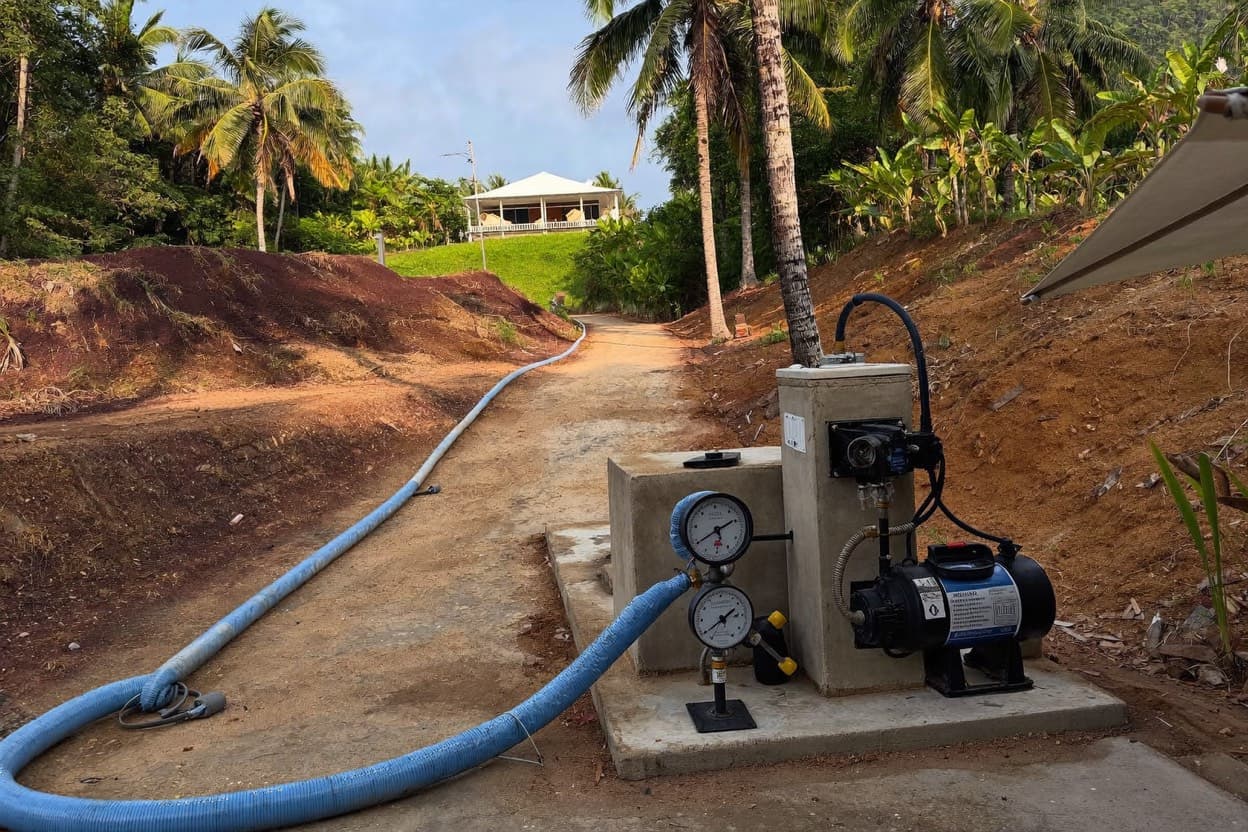
Low pressure is the most common complaint we hear from villa owners on Samui, and the most commonly misdiagnosed. The reflex purchase is a bigger pump. Sometimes that is the answer. Often the pressure is being lost somewhere the new pump cannot reach, and the money follows the old pressure out the same hole.
The causes are a short list, and they can be checked in order in an afternoon.
Where villa pressure comes from
Very few island properties run on mains pressure alone. The usual arrangement stores water in a tank and lifts it with a pump, so the pressure at your shower is whatever that pump produces, minus everything the water passes through on the way: filters, pipe runs, fittings, and any height it has to climb. Each of those subtractions is a suspect.
Cause one: the property is taller than the pump's job
Height converts directly into lost pressure. Roughly a tenth of a bar disappears for every metre the water climbs, which a bathroom two floors above the pump, or a guest suite further up the hillside, subtracts before the tap opens. A pump that was adequate for the original house is routinely outgrown by an extension above it.
On steep plots the honest fix is often not one stronger pump but a rearrangement: a break tank higher up, a second pressure zone, or a booster set dedicated to the upper court. Pushing the whole property to the pressure the top floor needs over pressurises everything below it, and the fittings pay for that over the following years.
Cause two: the pump itself
Pumps lose capacity as they wear, so pressure that has faded over months usually points at the machine, while pressure that was never good points at the sizing. A pump also cannot be judged in isolation: one that is strong enough on paper will still deliver weak, surging water if its pressure vessel has lost its air charge, or its controller is cutting in and out.
Short cycling, new noise, or breakers tripping alongside the weak flow mean the pump is telling you something more urgent than a pressure complaint.
Cause three: the water is fighting through a clogged filter
A loaded sediment cartridge or exhausted media bed throttles the whole house, and it does it gradually enough that nobody connects the fading showers to the filter nobody has changed. If the pressure is noticeably better before the filtration than after it, the diagnosis has already been made.
This one is worth checking first because it is the cheapest to fix and the easiest to prevent. A service schedule keeps the treatment working and the pressure honest at the same time.
Cause four: the pipework
Long runs of undersized pipe bleed pressure through friction, and a property that has grown wing by wing often pushes all of its demand through the original line. The symptom has a signature: pressure that is acceptable with one tap open and collapses the moment a second one joins. No pump upgrade cures a pipe that is too small for the property it now serves; the line itself has to be upsized or the load split.
Check in this order
- Confirm the tank actually holds water through the day, so the pump is not starving at the source
- Compare pressure before and after the filtration, and service anything loaded
- Watch the pump through a few cycles for short cycling, surging or new noise
- Open two or three taps together and see whether the pressure holds or collapses
- Only then size a pump, against the property's real height and demand
What a proper fix looks like
Matched equipment, not maximum equipment: a pump sized to the real head and flow, a healthy pressure vessel or a constant pressure controller to hold the delivery steady, filtration that is serviced on a schedule instead of on failure, and on hillside plots, zones so every level of the property gets the pressure it was designed for. None of that is exotic. It is the difference between a system that was calculated and one that was accumulated.
If the showers in a Samui, Phangan or Koh Tao property have gone quiet and the cause is not obvious, Deep Well Samui can survey the system, find where the pressure is going, and fix the stage that is actually responsible.