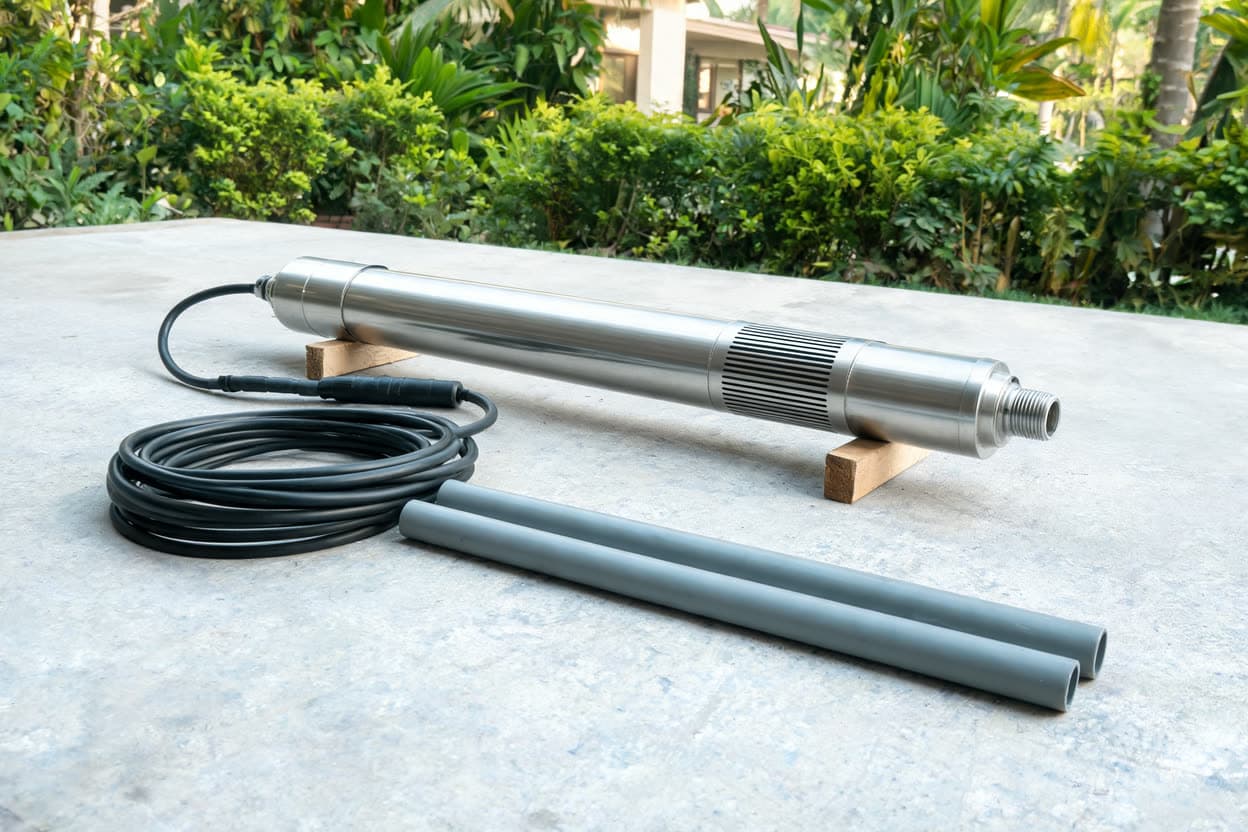
On a surface pump the cable is a few metres long and almost an afterthought. A submersible pump is different. Its motor sits far down the borehole, and the cable runs from the control panel, across to the wellhead and all the way down to the pump setting depth, carrying the full motor current the whole way. That length changes the electrical design, and getting it wrong is one of the quieter reasons deep well pumps fail early.
Why length costs voltage
Every conductor has resistance, and resistance increases with length and decreases as the conductor gets thicker. When current flows through that resistance, some voltage is lost along the way. So the voltage that arrives at the motor is lower than the voltage leaving the panel, and the difference grows with a longer cable, a higher current or a thinner conductor. The lost energy turns into heat in the cable.
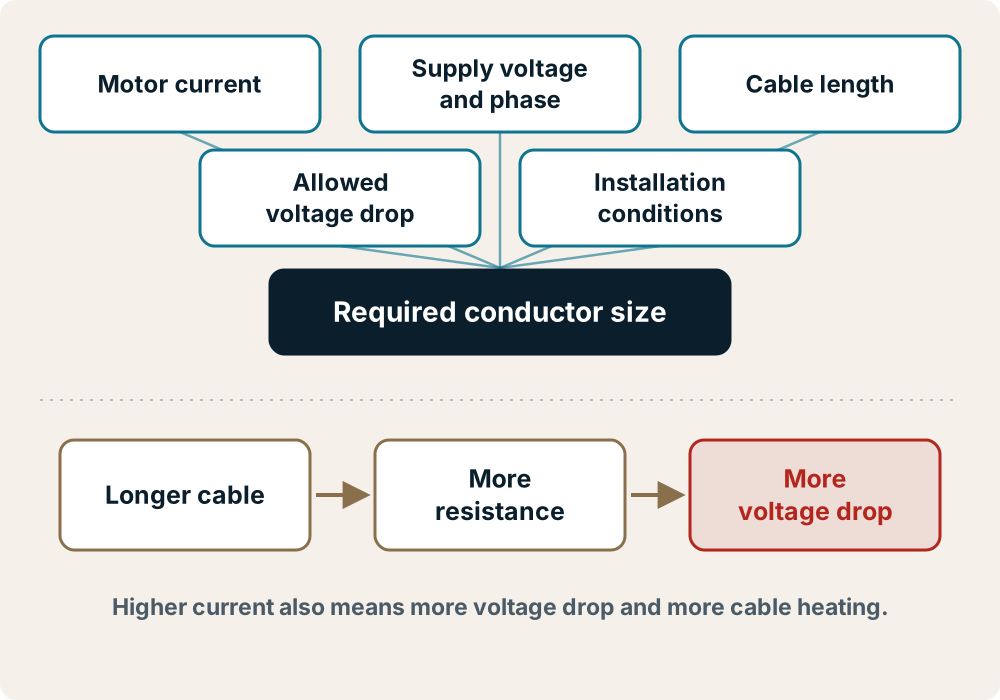
As a purely illustrative relationship: double the cable length and, with the same current and conductor, the voltage drop roughly doubles. Double the current and it roughly doubles again. That is why a deep setting with a powerful pump needs far more attention than a shallow well with a small one.
What low voltage does to the motor
A submersible motor under load that receives too little voltage tends to draw more current to keep turning the pump, and more current means more heat in both the motor and the cable. It may also struggle to start. At start-up a motor draws a multiple of its normal running current for a moment, so the voltage drop at that instant is far larger than during normal running. A cable that seems adequate while the pump runs can still leave the motor too little voltage to start cleanly. Repeated hard or failed starts are hard on windings and starting components.
Island supply adds its own margin of uncertainty. Where the incoming voltage already sags at busy times, losing more along an undersized cable pushes the motor further from its rated conditions.
How cable size is actually worked out
Choosing a cable by the motor's horsepower alone leaves out most of the variables that matter. A proper selection starts from:
- The motor's rated current, from the manufacturer's data rather than an estimate
- The supply voltage and whether the motor is single-phase or three-phase
- The total cable length from the panel to the motor, which is the setting depth plus the run to the wellhead and the panel, not the well depth
- The voltage drop allowed by the applicable electrical rules and the motor manufacturer
- The installation conditions: cable submerged in the well, in conduit in the sun, or bundled with other cables
From those, the conductor size is calculated so that the voltage at the motor stays within limits at full load and the motor can still start properly. Pump and motor manufacturers publish cable selection data for their own motors, and that data, together with the applicable standards, is what a correct selection should be based on. Because the result depends on the actual motor, length and installation, this article deliberately does not give a size-by-power table: any such table would be wrong for many real installations.
Single-phase and three-phase
Many villa pumps run on single-phase supply, which is what most houses have. For larger pumps, three-phase supply carries the same power with less current in each conductor and gives smoother starting, which can ease the cable problem on long runs. Whether three-phase is available, and whether it is worth arranging, depends on the property's connection and the size of the pump. Single-phase submersibles also use starting components, often in a control box at the surface, that need to match the motor.
Joints, support and protection underwater
The drop cable usually meets the motor's own short lead in a splice down the well, and that joint lives permanently underwater. It must be made with a proper watertight splice method, because a joint that lets water in will eventually cause an insulation fault. The cable is fixed to the riser pipe at regular intervals so its weight is not hanging from the connection, with some slack allowed where the pipe stretches under load. At the wellhead it needs protection from sharp casing edges, and during installation and removal it has to be guided so it is not crushed or scraped against the casing.
Deep Well Samui designs and installs submersible pump systems across Samui, Phangan and Koh Tao with the cable calculated for the actual motor, setting depth and supply, and the joints made to last underwater. If your pump has failed more than once, or you are replacing one with a larger model, the cable belongs in the check.