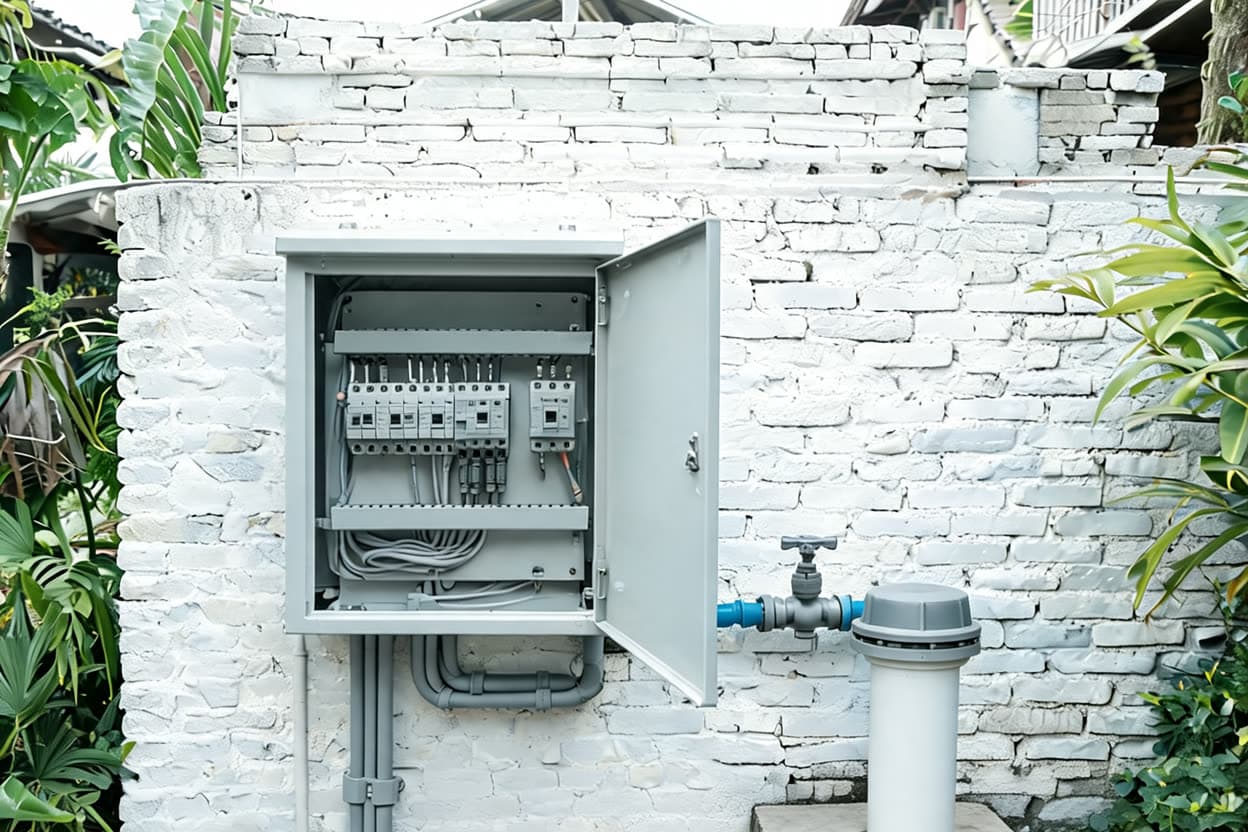
A submersible pump sits deep in a borehole where nobody can see it. The control panel is the part of the system an owner or technician can actually reach, and it is where most of the decisions are made: when the pump runs, how it starts, what protects it and what tells someone that something is wrong. Understanding what the panel does makes it far easier to describe a problem, and to avoid making one worse.
Panels vary a great deal. A simple installation might have a breaker, a starter and a float switch. A larger one might add a drive, several sensors and an alarm. Not every panel contains every function described here, and the arrangement depends on the pump, the supply and the way the system was designed.
Four jobs in one box
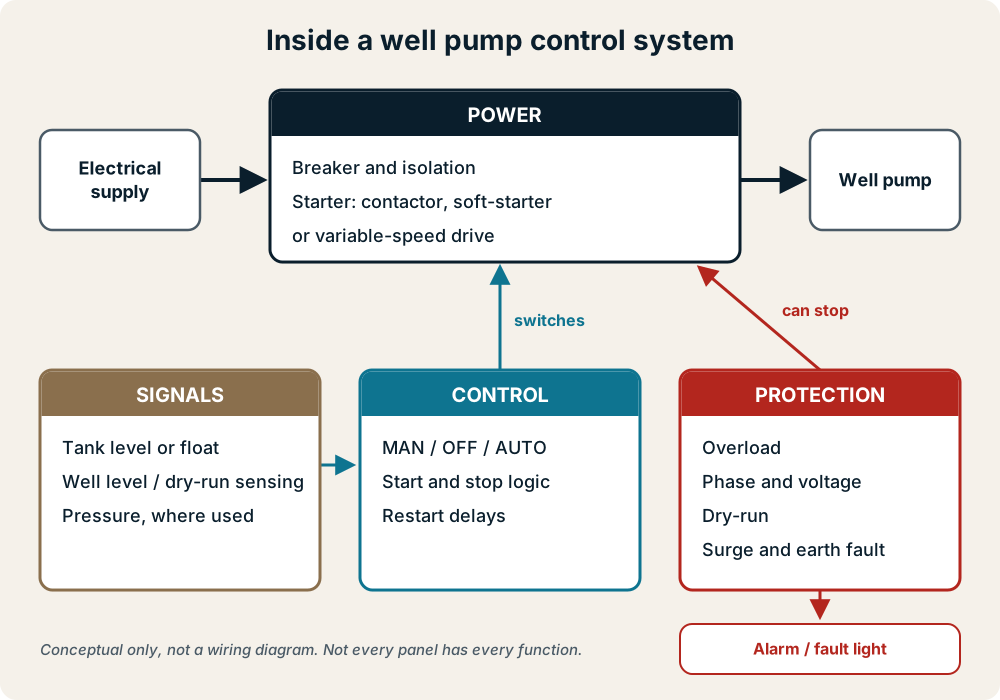
It helps to think of a pump panel as doing four different jobs that are wired together. Power is the path electricity takes from the supply to the motor. Control is the logic that decides when that path is switched on. Protection is the set of devices that switch it off when conditions are unsafe. Signals are the inputs from outside the panel, such as level sensors or a tank float, that the control logic acts on.
Power: getting electricity to the motor safely
On the power side, a protective device such as a breaker isolates and protects the circuit, and a contactor or starter does the actual switching of the motor on and off. Single-phase submersibles also need starting components matched to the motor, and some installations use a soft-starter or a variable-speed drive in place of a simple contactor to bring the motor up to speed more gently. The cable from the panel to the motor is part of this path too, and its size is a design decision in its own right.
Control: deciding when the pump runs
In a typical villa system the well pump runs to fill a storage tank, and the call for water comes from a level signal in that tank: when the level falls the pump is allowed to start, and when the tank is full it stops. Some systems run the pump from a pressure signal instead. The control logic also handles timing, such as restart delays after a trip, and the mode selector that most panels carry.
- AUTO: the normal setting, where the panel runs the pump according to its signals and protection
- OFF: the pump will not run, which is the setting for safe isolation of control, though not a substitute for proper electrical isolation before work
- MAN: the pump runs on demand, usually for testing or commissioning; what protection remains active in MAN depends on how the panel was designed
That last point matters. On many panels MAN bypasses the level control, and on some it bypasses more than that. Leaving a pump in MAN to keep water flowing while a fault is unresolved can run it dry or overfill a tank. MAN is a test position, not a fix, unless the panel was specifically designed to be operated that way.
Protection: what stops the pump
Protective functions switch the motor off when running it would cause damage. Overload protection trips when the motor draws more current than it should for too long. Phase protection, on three-phase supplies, guards against a missing phase or phase imbalance. Dry-run protection stops the pump when it is running without enough water. Many panels add surge protection, which matters on island supply, and earth-fault protection as required by the electrical rules. Each of these is set for the actual motor and installation, not to a general value.
Why a healthy pump may not start
When a pump does not run, the motor is often the last thing at fault. Before anyone pulls a pump from a deep well, it is worth knowing how many reasons the panel itself can have for keeping it off:
- No call for water: the tank is already full, or the level signal says it is
- Low-water protection is active and waiting for the well level to recover
- An overload or other protective device has tripped and needs investigation before reset
- A supply problem, such as a missing phase or low voltage, is being detected
- The mode selector is in OFF, or a restart delay has not yet finished
- A sensor, float or its wiring has failed, so the panel is acting on a false signal
- A fault in the control circuit itself, such as a failed relay or contactor coil
Many of these can be read from the panel's indicators, which is why a panel with clear fault indication saves so much diagnostic time. All of them involve mains voltage and a pump that can start without warning, so the checking belongs to someone qualified to work on it.
Deep Well Samui designs, installs and diagnoses pump control panels across Samui, Phangan and Koh Tao, matching the starting method, protection and level control to the pump and the property. If your pump stops for no obvious reason or the panel was assembled piecemeal over the years, an inspection will show what it is actually doing.