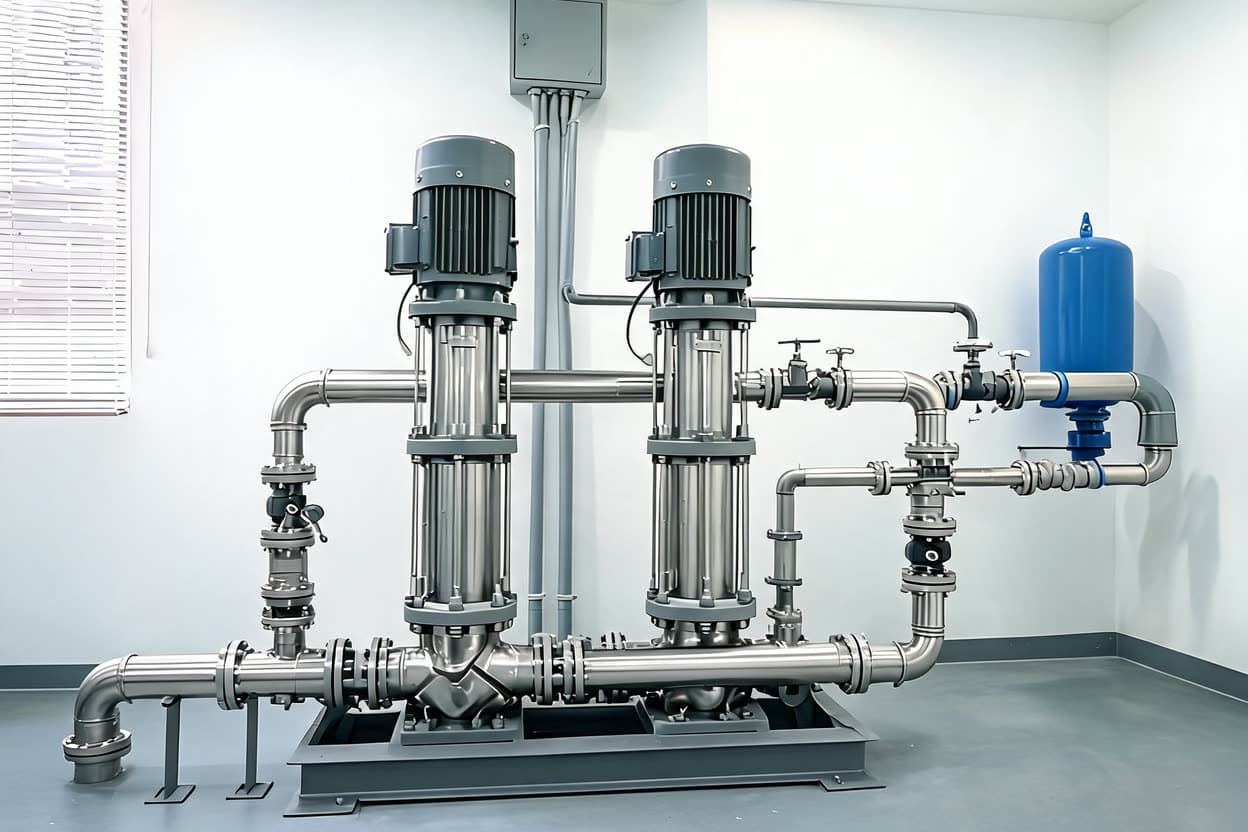
Most villas run on a single booster pump that draws from the storage tank and pressurises the house. When it fails, the house has no pressure until it is repaired or replaced. For a private home that is an inconvenience. For a rental villa with guests arriving, a multi-villa property sharing one plant, or a small resort, it is an operational failure. A set of two or more pumps working together is the usual answer, but how they work together matters more than how many there are.
Two pumps, two different goals
Pump sets are usually described by the job the second pump does. In a duty and standby arrangement, one pump normally carries the whole load and the other waits. If the duty pump fails, trips or is taken out for service, the standby takes over. The goal is continuity: each pump is chosen so that it can meet demand on its own, and the second exists for when the first cannot.
In a duty and assist arrangement, one pump runs during normal demand and the second joins when demand rises beyond what one pump should handle, then drops out again as demand falls. The goal is capacity across a wide range of demand. Many sets combine both ideas: pumps that help each other at peaks, and that can each keep at least part of the property supplied if the other is out of service.

The difference changes the design. A duty and standby set chooses each pump for the full peak. A duty and assist set may choose each pump for only part of it, which means that losing one pump during a peak leaves the system short. Neither is wrong, but the owner should know which one they are paying for.
What two pumps do not do
A common assumption is that two pumps give twice the flow or twice the pressure. Neither follows automatically. Pumps running in parallel into the same pipework share the system's resistance, and the extra flow from the second pump depends on how steeply that resistance rises as flow increases. In a system with long or narrow pipes, the second pump may add much less than the first. Pressure does not double either: pumps in parallel add flow, not pressure. Actual performance comes from the pump curves, the pipework and the control strategy together, which is why a pump set is designed as a system rather than bought as a pair.
Alternation and balancing the hours
A standby pump that never runs is a gamble. Seals can stick, bearings can suffer from long idle periods in humid air, and nobody finds out until the day it is needed. Most well-designed sets alternate the duty role between pumps, so each runs regularly and the running hours stay roughly balanced. Both pumps then wear at a similar rate, which makes servicing predictable. Whether alternation happens on each start, on running time or on a schedule is a control setting chosen for the installation.
What the rest of the system needs
A second pump is only as useful as the arrangements around it. Each pump normally needs its own isolation valves, so one can be removed while the other keeps running, and its own non-return valve, so the running pump does not push water backwards through the idle one. Without isolation the whole set has to be shut down to service either pump, which defeats much of the point.
- Controls that start, stop, alternate and change over between pumps, and that raise an alarm when the duty pump fails rather than switching silently
- Pressure sensing and a pressure vessel arranged for the set as a whole, so the pumps do not fight each other or cycle rapidly
- Protection on each pump, including dry-run protection where the tank can run low
- Suction pipework from the tank designed for the pumps that may run together
Variable-speed drives are often used on pump sets too, and many constant-pressure packages are built as multi-pump sets. That combination changes how the pumps share the load, and it is covered in the variable-speed guide. The redundancy principles here still apply.
Storage still comes first
Two booster pumps protect the house from a pump failure. They do nothing if the tank they draw from is empty. A duty and standby booster set belongs with storage that can carry the property through a well pump fault, and in larger systems with a standby arrangement on the well or transfer side too. Redundancy is only as strong as the single component nobody duplicated.
Where a pump set makes sense
- Rental villas, where a failure during a booking costs revenue and reviews
- Multi-villa properties sharing one technical plant
- Small resorts and hospitality properties with guests on site
- Properties with high or widely varying demand, such as several bathrooms, irrigation and pool make-up running at once
- Sites where a repair visit may take time, such as remote plots or busy seasons
A small private villa with modest demand, a reliable pump and an owner who can tolerate a short outage often does not need one. A second pump adds cost, space, valves and control complexity, and every extra component is something else to maintain. There, a single well-chosen pump, a known service contact and sensible storage may be the better investment.
Deep Well Samui designs and installs booster and transfer pump sets for villas, multi-villa properties and resorts across Samui, Phangan and Koh Tao, chosen around demand, the reliability the property needs and how it will be serviced. If an outage would be expensive for your property, we can assess whether a second pump is worth it.