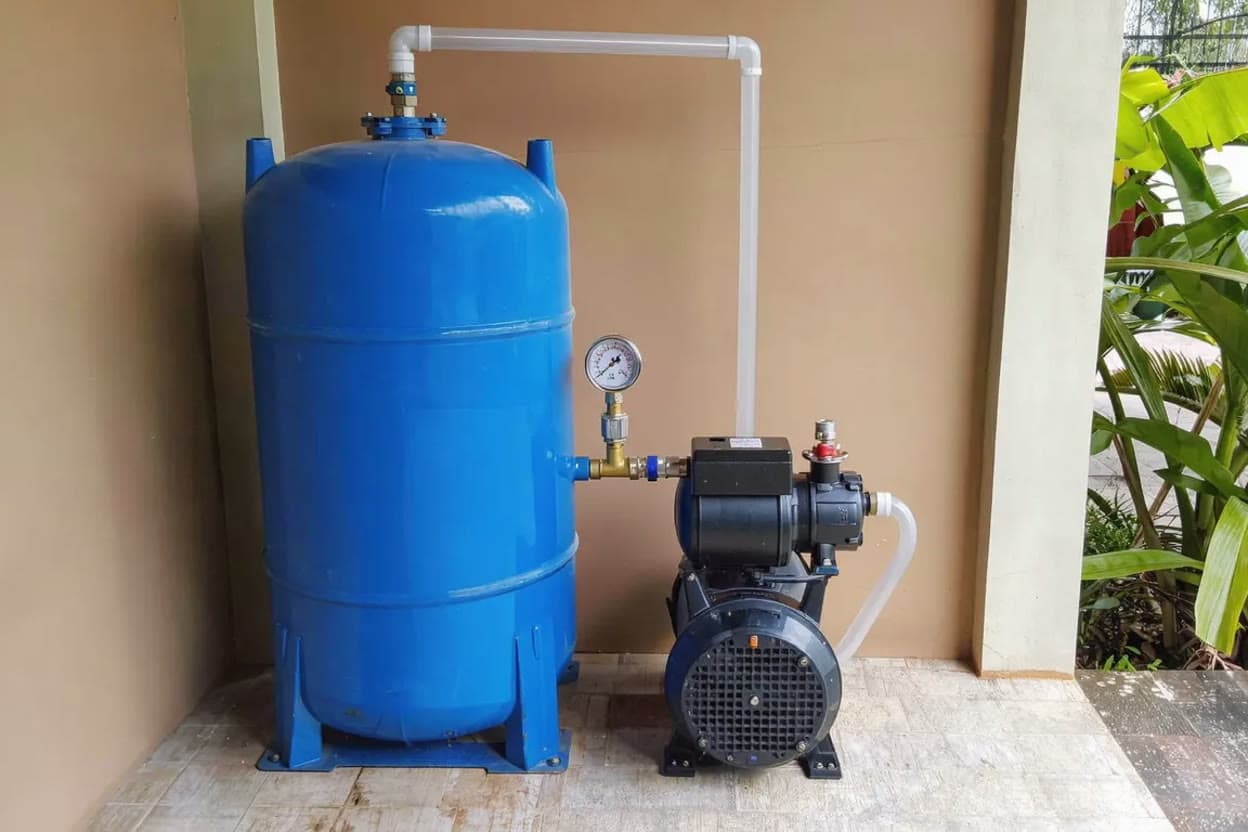
Two tanks live in most island water systems and they get confused constantly. The big one, thousands of litres, stores water. The small one beside the pump stores pressure. Owners routinely assume the big tank makes the small one unnecessary, or that a bigger small tank means better showers. Both assumptions cost money, and one of them quietly kills pumps.
What a pressure tank actually does
Inside a modern pressure vessel a rubber bladder separates water from a charge of compressed air. When the pump runs, water squeezes the air. When a tap opens, the air pushes the water back out. That air spring does two jobs: it serves small draws without waking the pump, and it stretches the gap between the pump's cut-in and cut-out pressures into a proper work cycle rather than a flicker.
Remove the vessel, or let its air charge leak away, and every draw of water becomes a pump start. A tired pressure vessel is the most common cause of short cycling we find on the islands.
A storage tank is not a big pressure tank
A three thousand litre polyethylene tank behind the pump house cannot substitute for a pressure vessel, and no quantity of storage litres changes that. The two do different work at different pressures in different places:
- Purpose: the storage tank holds a reserve of water for the property; the pressure vessel holds pressure so the pump can rest between draws
- Size: storage is measured in thousands of litres, a pressure vessel in tens
- Pressure: storage sits open to atmosphere; the vessel holds an air charge at system pressure
- Position: storage comes before the pump, often outdoors or elevated; the vessel sits after the pump, beside it
- Effect on the pump: storage has none by itself, while the vessel directly sets how often the pump starts
Drawdown is the only volume that counts
A pressure vessel's label size is not what you get. The usable amount, called drawdown, is the water the vessel can actually deliver between cut-out and cut-in pressure, and it is always a fraction of total volume, often around a quarter to a third depending on the pressure settings. A vessel sold as sixty litres may hand the house perhaps fifteen to twenty usable litres per cycle. Sizing works in drawdown, never in label litres.
How sizing actually works
The calculation starts at the pump rather than at the number of bathrooms. Motors have a maximum healthy number of starts per hour, and the drawdown is chosen so that, at the pump's real flow rate, each cycle runs long enough to keep starts under that ceiling. A stronger pump therefore needs more drawdown, not less, because it refills the vessel faster and only a bigger cushion keeps its run times civilised.
The property enters second, through its demand pattern. A two bedroom house with a garden tap produces short scattered draws that a modest vessel absorbs. A six bathroom villa with irrigation zones and a pool top-up line produces long overlapping draws, and its vessel, or bank of vessels, is chosen with those in mind. The arithmetic itself is simple. The inputs are the pump curve and the pressure settings, which is why the honest answer differs from system to system and why a published universal tank size would be worth nothing.
Bigger is not automatically better
Past the size the calculation asks for, extra drawdown buys very little. The pump rests longer between runs but runs longer too, the total number of starts falls slowly, and the vessel costs and occupies considerably more. Oversized vessels on small systems also hold water longer, which matters where the groundwater carries iron and standing time deepens staining. The failure in the other direction is worse: a vessel that is too small short cycles the pump from the first day, and the system spends years paying interest on the litres saved at purchase.
Inverter driven constant pressure pumps change the arithmetic. They vary motor speed instead of cycling, and need only a small vessel to stay stable. They suit properties that want steady pressure across varying flows, and they belong in the conversation when a pump set is specified rather than being bolted on later.
Getting it right for a specific property
Sizing a pressure system means knowing the pump's curve, the pressure band the house runs at, and the real simultaneous demand: bathrooms that overlap, irrigation on timers, a pool that tops up in the afternoon. That is a short survey rather than a study. Deep Well Samui specifies the vessel, the switch settings and the pump together, as one matched set, and checks the pre-charge at every service visit afterwards.