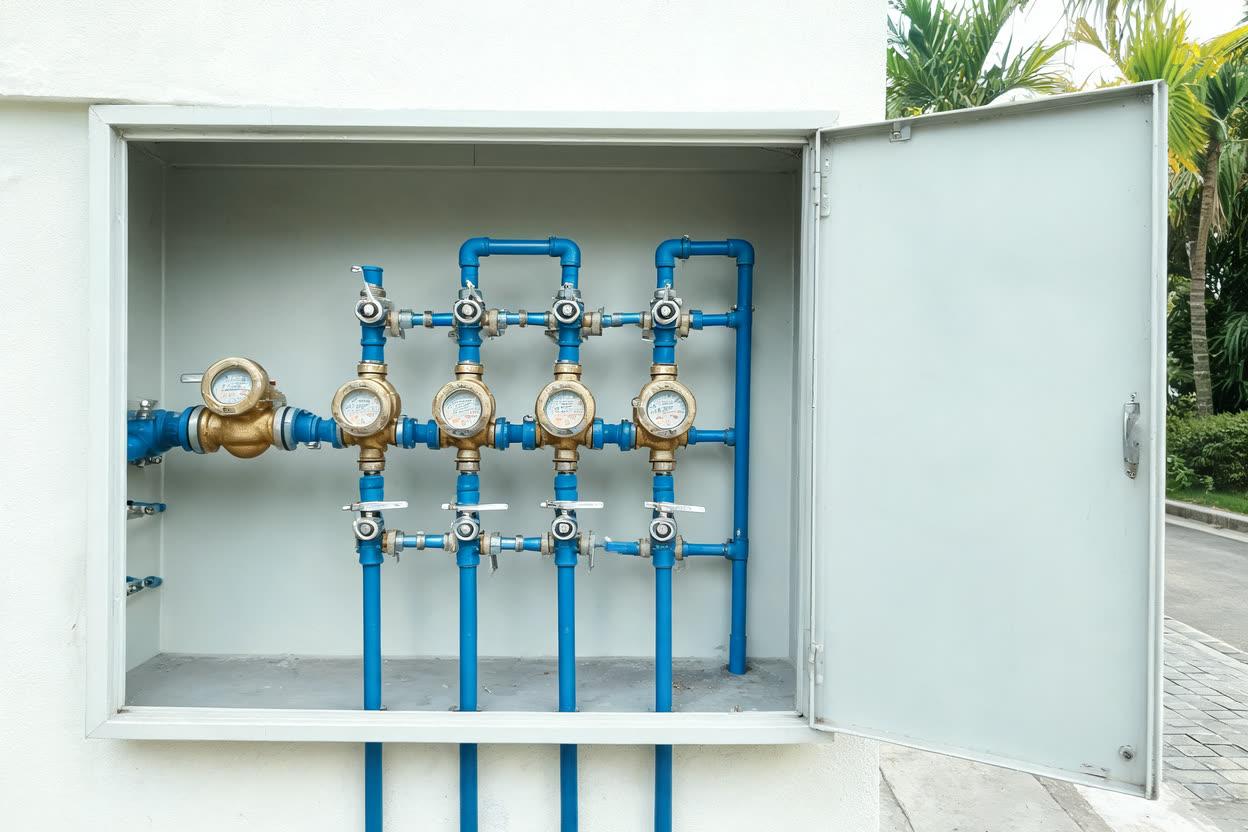
A development that shares one well, one storage bank and one treatment plant among several villas has solved the hard engineering problem. It then meets a softer one: who used the water. Without meters on the individual branches, the only number anyone has is the total, and a total cannot tell a leaking irrigation line from a villa with guests, or settle a dispute about who should pay for the pump's electricity. Sub-metering is how a shared system becomes manageable after it is built.
What a single main meter cannot tell you
A meter at the plant measures everything the system supplies. That number is useful: it shows how hard the well and pumps are working and how consumption moves through the seasons. What it cannot do is attribute. If the total rises, the plant meter cannot say whether villa three filled its pool, the common garden irrigation ran twice as long, or a buried pipe has been leaking since the last reading. Every one of those has a different owner and a different fix, and the main meter sees them as the same cubic metres.
What sub-metering gives a shared system
- Visibility: each villa and each shared function has its own consumption history
- Early warning: a branch whose reading climbs while the villa is empty is a leak until proven otherwise
- Fair cost allocation: shared operating costs can follow actual use rather than a flat split
- Accountability for the big consumers: irrigation and pools are measured instead of guessed
- Capacity planning: real per-villa demand replaces assumptions when the scheme grows or the well is retested
- Fewer disputes: a reading is easier to agree on than a recollection
None of this requires a billing system. A cluster of a few villas can read the meters monthly and keep a shared sheet. What matters is that the meters exist and are read on a routine.
Where meters go
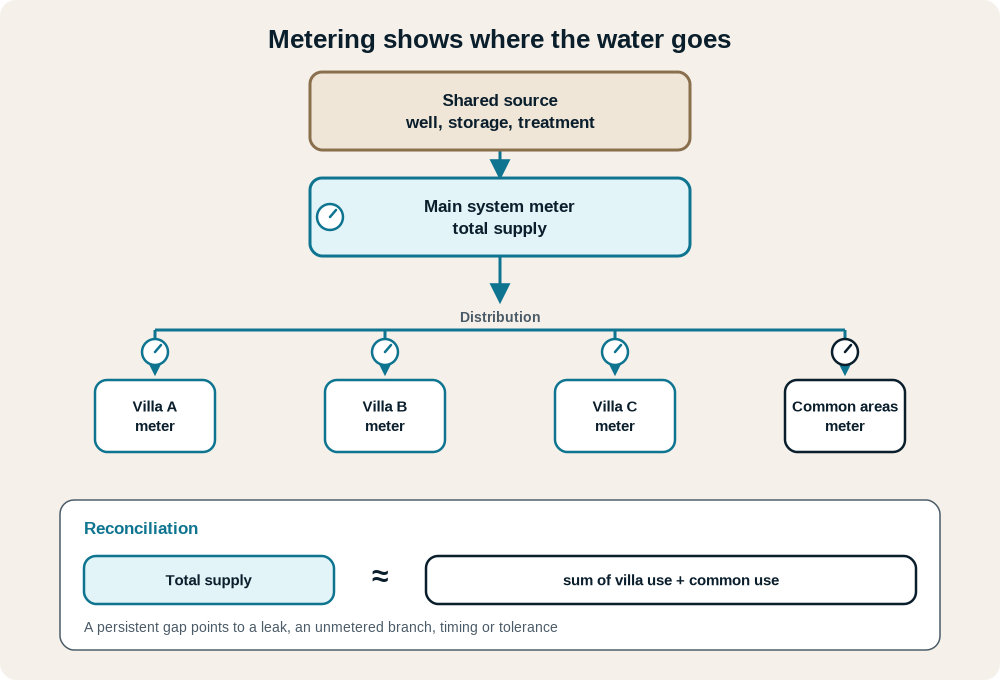
The conceptual map is simple. One meter on the supply side records total production. Then a meter on the branch feeding each villa, placed where that branch leaves the common network rather than somewhere inside the house, so that everything downstream of it is unambiguously that villa's. Irrigation that runs off the common network earns its own meter, because garden water is usually the largest and least predictable draw. Pools, staff quarters, a clubhouse or a laundry are treated the same way: anything that is shared, or that is large, gets measured on its own.
Where the pipe network was built without these branch points, meters end up wherever a pipe happens to be accessible, which often means one meter covering two villas or none covering the garden. That is why metering belongs in the pipe design, not in the fit-out.
Reconciling the readings
Once the meters exist, the most useful habit is to compare them. On the same day, read the main meter and every sub-meter, and set the total against the sum of the branches. The two will rarely match exactly, and the gap is information. A small, steady difference is normal: meters have tolerances, readings are not simultaneous, and some water sits in the network between them. A difference that grows from one month to the next, or that appears suddenly, usually has one of a few explanations:
- Common-area use that nobody metered: a garden tap, a construction connection, a fountain
- An unmetered or forgotten branch
- A leak in the common network, between the main meter and the sub-meters
- A meter that has stopped or slowed, often after sediment or air has passed through it
- Readings taken days apart, so the periods do not line up
A leak between the main meter and the villas is the one worth finding fast, because it is water pumped, treated and paid for by everyone, and it often shows up nowhere else until a wet patch appears.
A meter that cannot be read is decoration
The practical requirements are unglamorous. The meter has to be readable without tools or a ladder, which rules out the bottom of a flooded pit or a position behind a tank. It has to be serviceable: isolation valves on either side so it can be removed for checking or replacement, and a union so the removal does not mean cutting pipe. It has to be protected from sun, traffic and garden tools, and installed in the orientation and with the straight pipe lengths its manufacturer specifies, because a meter fitted sideways or right after an elbow may not register what it should. And it has to be labelled with what it measures, since a cabinet of identical meters is useless the day the person who installed them is not available.
Who reads them, how often, and where the numbers are kept should be agreed in the same document that sets out how the shared system is owned and maintained. Meters that are read when someone remembers produce arguments instead of answers.
Deep Well Samui designs shared water systems for villa clusters and small developments across Samui, Phangan and Koh Tao, with the branch points and meters built into the network from the start. If an existing scheme runs on one meter and a lot of goodwill, we can assess where sub-meters can still be fitted.