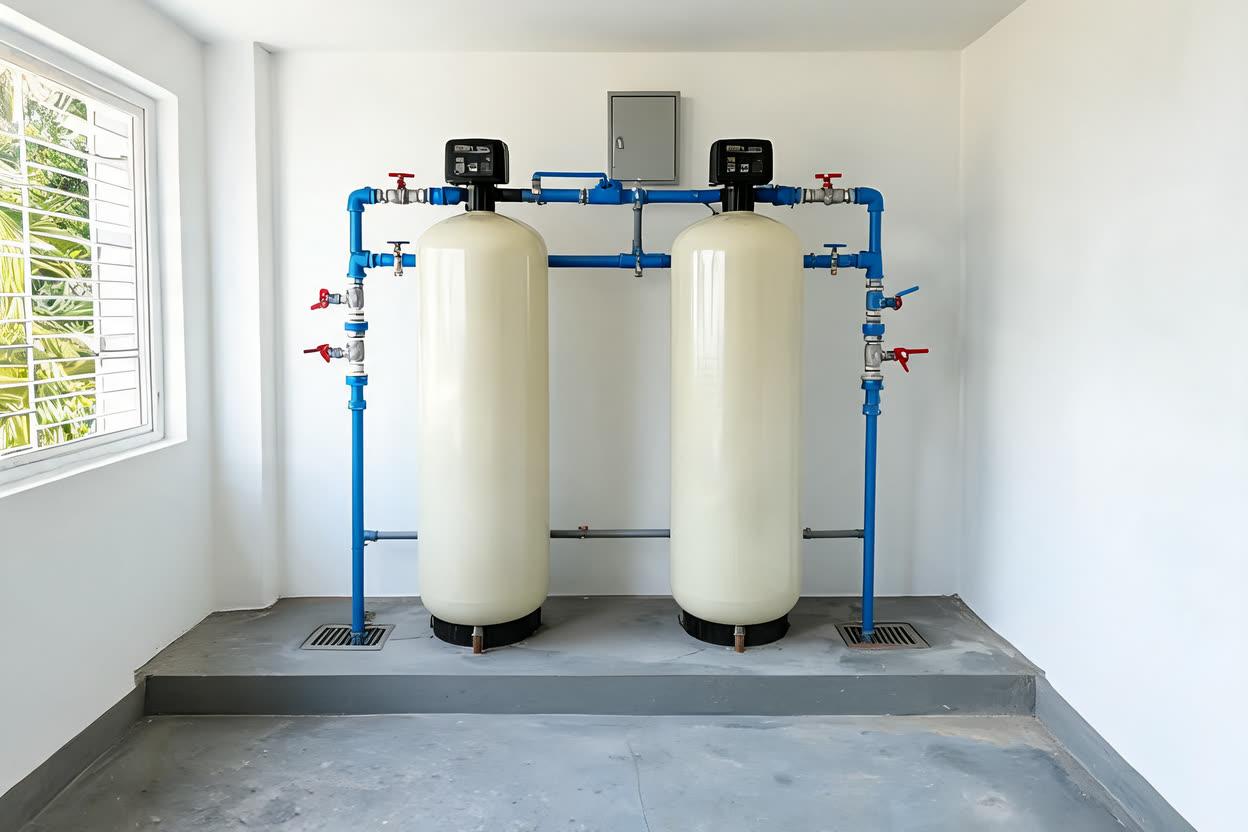
Most villa filtration systems are installed to solve a water problem and never designed to be serviced. The vessels go wherever they fit, the pipe runs straight in and straight out, and the first time a media bed needs replacing the whole house loses water for a day while someone cuts pipe. A serviceable layout costs a few valves and some floor space at installation and saves that scene every year afterwards. This article is about that layout: how the equipment is connected, isolated and reached. Which treatment the water needs, and where the tanks sit around it, are covered elsewhere.
What a bypass is, and what it is not
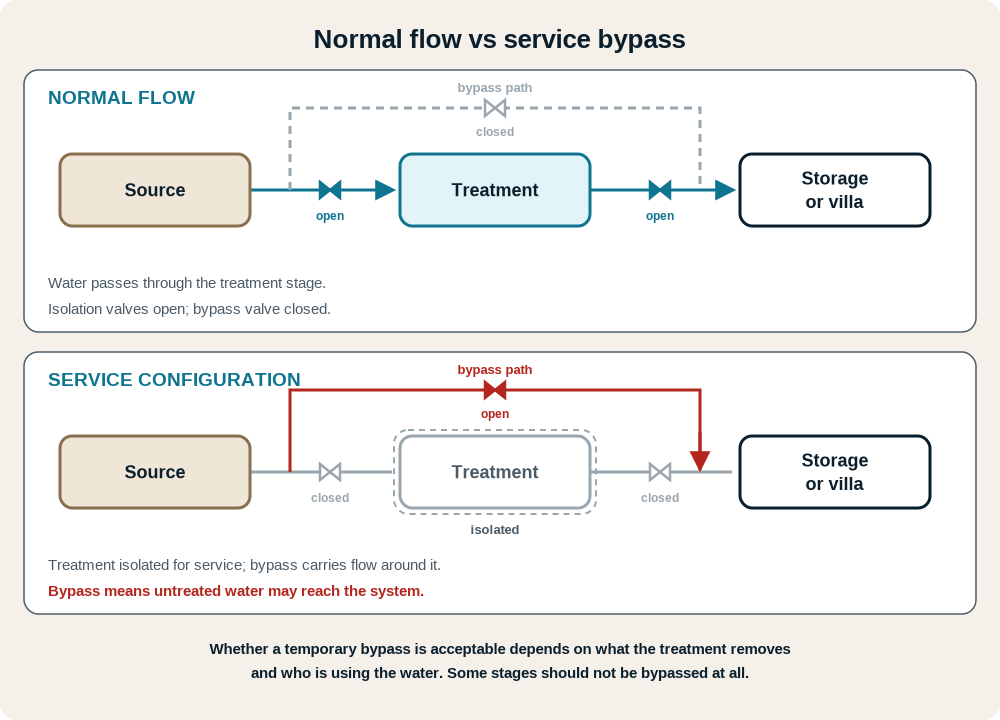
A bypass is a pipe that lets water go around a piece of equipment instead of through it. On a filtration system it is usually a short link from the pipe entering the treatment to the pipe leaving it, with its own valve. Together with an isolation valve on each side of the equipment, it gives the installer three positions: normal flow through the treatment with the bypass shut, the equipment isolated with no flow anywhere, or the equipment isolated with flow continuing around it.
The third position is the one that causes trouble when it is misunderstood. A bypass exists so that a filter can be serviced without shutting the whole property down. It is not a second way of running the house. Water taking the bypass has had nothing done to it, so whatever the treatment was installed to remove is arriving at the taps for as long as the bypass is open. For a sediment stage on garden water that may not matter for an afternoon. For a stage that removes iron, softens hard water or disinfects a drinking line, it can mean stained laundry, scaled heaters or water that is not safe to drink.
The parts of a serviceable layout
The exact arrangement differs with the equipment and the space, and no single valve layout is right for every system. The functions, though, are the same almost everywhere:
- Inlet and outlet isolation on each vessel or stage, so one unit can be shut off while the rest keep working
- A bypass with its own valve, normally closed, and ideally arranged so that it is obvious when it is open
- Unions or removable couplings next to each vessel, so it can be disconnected without cutting pipe
- A drain at the low point of each stage, and a route for backwash water to a suitable discharge
- Gauges or sampling points before and after the treatment where the process warrants it, so performance can be checked without dismantling anything
- A strainer or check valve where the equipment maker calls for one, protecting downstream components from debris or backflow
Pressure readings before and after a filter are the cheapest diagnostic a system can have: a growing difference between them says the stage is loading up long before the showers notice.
Space is part of the design
Media vessels are serviced from the top and emptied from the bottom. Replacing a media bed means lifting the control head off, getting the old media out and pouring new media in, which needs standing room beside the vessel, headroom above it and a path to carry sacks and buckets in and out. Cartridge housings need room to unscrew the bowl. Backwashing equipment needs a drain within reach. A vessel pushed into a corner with pipework across its front is serviced by dismantling the pipework first, every time.
On a villa site the technical area is usually the last space allocated and the first to be squeezed. Deciding the filtration footprint early, when the technical room or yard is still on the drawing, is far cheaper than a second room later.
Deciding the maintenance strategy
The valve layout only answers the question of what is physically possible during a service. What should actually be done depends on the property, and it is worth settling in advance rather than at the moment a technician arrives with the water running:
- Can the water be shut off for the duration of the job? An empty villa can; a full one often cannot
- If not, is a temporary bypass acceptable for this stage, for this long, for these users?
- Which stages must never be bypassed? Disinfection on a drinking line, or treatment for a known health-related contaminant, usually sit in this group
- Does a treated-water reserve exist that could carry the house through the service with no bypass at all?
- Can the technician reach everything, and does the owner or manager know where the valves are?
A treated-water tank changes the answer to most of these. Where the house draws from a reserve that was filled before the service, the treatment can be isolated completely for the length of a normal job, and the bypass is never opened. That is one of the quieter arguments for two-stage storage.
Keeping the bypass honest
The failure mode is not the bypass being used; it is the bypass being forgotten. A valve opened for a two-hour service and left open sends untreated water into the house for months, and nobody notices until the staining or the scale returns. Simple habits prevent it: the bypass valve is a different colour or carries a tag, the service record notes when it was opened and closed, the treated-water quality is checked after any service, and on rental properties the manager knows that an open bypass is a fault to report rather than a setting.
Deep Well Samui designs and installs filtration for villas and resorts across Samui, Phangan and Koh Tao with the service layout built in: isolation, bypass where appropriate, drains, access and a plan for who does what at each service. If an existing system has to be cut apart every time a filter is changed, a valve retrofit is usually a small job.