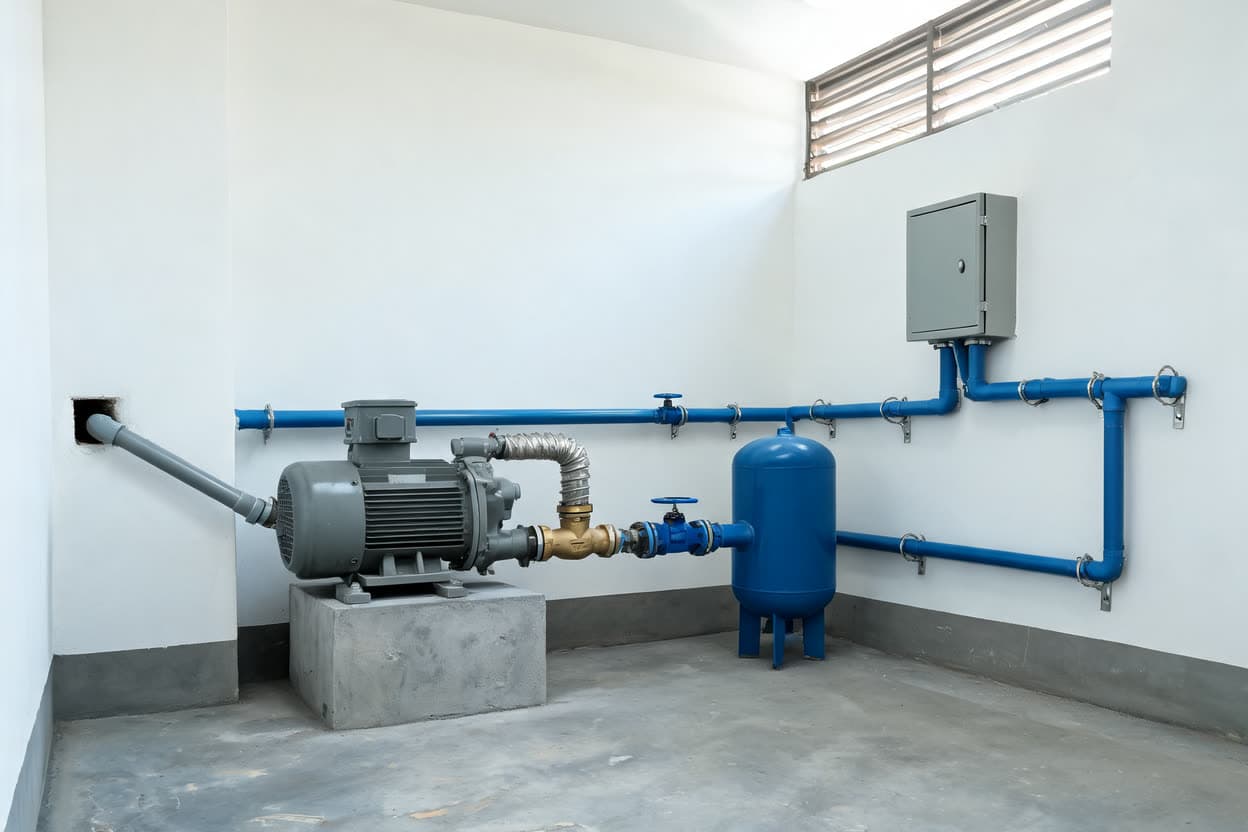
A bang from the pipework when the pump stops. A thud when a tap is shut. A rattle that comes and goes while the shower is running. These noises are easy to live with and easy to misread. Some of them are water hammer, a pressure surge caused by moving water being stopped too quickly. Some are something else entirely. Telling them apart matters, because the fixes are different and the wrong one, often a new pump or a new valve chosen on a guess, changes nothing.
What water hammer is
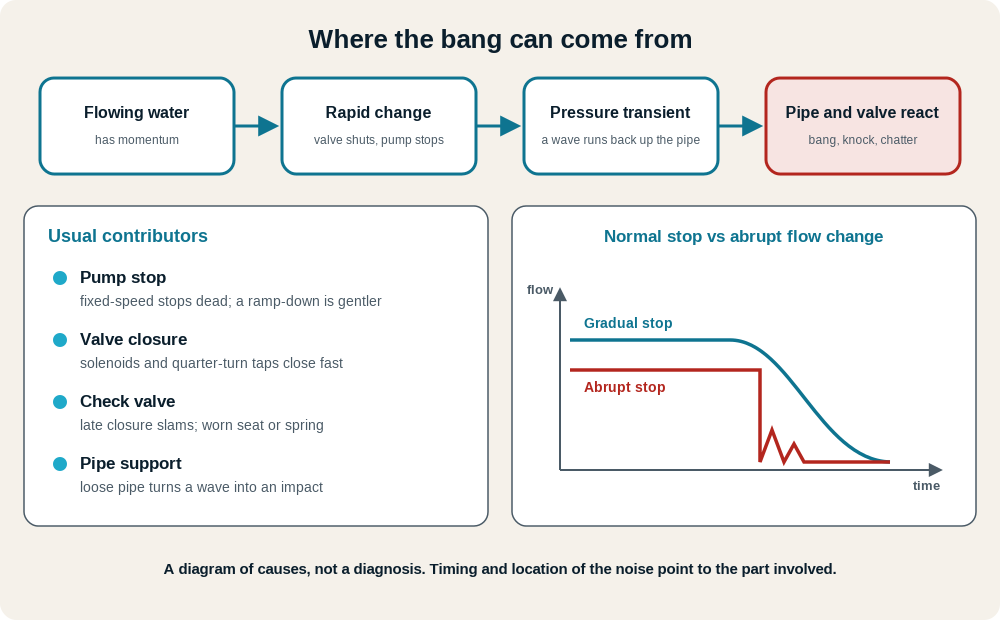
Water in a pipe has mass, and when it is moving it has momentum. If the flow is stopped abruptly, by a valve snapping shut or a pump stopping, that momentum has to go somewhere. It becomes a pressure wave that travels back along the pipe, reflects, and travels again until friction absorbs it. The bang is the pipe reacting to that wave. The faster the water was moving, the longer the pipe run and the more sudden the stop, the stronger the surge. A pipe that is not held firmly then moves with each wave, which is where the knocking against walls and joists comes from.
What people notice
- A single bang the moment the pump stops
- A thud when a solenoid valve closes: washing machines, dishwashers and irrigation controllers all close fast
- Pipes that visibly move or knock inside a wall when a tap is shut
- A rapid chatter or buzz from near the pump or a check valve while water is flowing
- Pressure that jumps or dips oddly around pump starts and stops
Not every bang is water hammer
Pipes also make noise for reasons that have nothing to do with surge. A pipe that expands as hot water runs through it ticks and creaks against its clips. A pump that starts and stops every few seconds thumps because it is short cycling, and the cause is a pressure vessel or a leak, not hammer. Air trapped at a high point gurgles and spits and can make a tap bang when it clears. A loose pipe clip rattles with ordinary flow. A worn tap washer can make a pipe moan or vibrate while it is open. The useful distinction is timing: hammer happens at the instant flow is stopped or changed sharply. Noise that comes while water is flowing steadily, or long after the tap is shut, is usually something else.
The role of the check valve
A check valve, or non-return valve, lets water pass one way and closes against flow in the other. In a well system it holds the column of water in the riser when the submersible pump stops, so the pump does not have to refill the pipe every time it starts and the pressure does not drain back into the well. On the booster side it keeps the house pressure from pushing back into the tank. The valve matters for hammer because of how it closes. One that shuts promptly as flow stops closes against water that is nearly still. One that stays open until the flow has already reversed slams shut against moving water, and that slam is the bang. A valve of the wrong type or size for the flow, one installed where the pipe geometry works against it, or one whose spring or seat has worn, can all behave this way. A valve that is failing to seal at all shows up differently: pressure that falls on its own and a pump that restarts with every tap closed.
Where the valve should sit, and what kind suits a particular installation, depends on the pump, the pipe run and the pressure the system works at. There is no placement that is right for every system, which is why this is a design question rather than a rule to copy.
Other contributors
Pump control plays a part. A fixed-speed pump stops dead, and so does the flow it was driving. A soft-starter or a variable-speed drive ramps the pump down over a moment, which is one reason those systems are usually quieter. A pressure vessel absorbs some of the surge, provided it still holds its air charge. Pipe velocity matters: undersized pipe carrying a lot of water moves it fast, and fast water hits harder when it stops. Long runs between the pump and the house store more momentum than short ones. And support is the quiet factor behind most of the knocking: a surge in a pipe that is clipped properly is a sound, while the same surge in a pipe that can move is a sound plus an impact.
Why repeated hammer should not be ignored
A single bang does no harm. The same surge repeated thousands of times a year is a fatigue load on everything in its path: pipe joints, especially solvent-welded plastic ones, fittings, valve seats, flexible connectors, the pressure vessel's diaphragm and the pump's own seals. The damage is slow and usually shows as a weep at a joint or a part that fails early, rather than anything dramatic. Severe hammer in a long run can crack a fitting outright. None of that is a reason for alarm over an occasional thud; it is a reason to find the cause of a regular one.
Diagnose, then change one thing
A useful diagnosis starts with when the noise happens and where it is loudest. Pump stop, valve closure, or during flow each point to a different part of the system. From there a technician will look at the check valve's type, condition and position, the pump's stopping behaviour, the pressure vessel's charge, the pipe sizes and the supports, and change the thing the evidence points at. Replacing the pump because the pipes bang is the most expensive way to find out the pump was fine.
Deep Well Samui diagnoses noisy and surging pump systems across Samui, Phangan and Koh Tao, from the check valve at the bottom of the well to the clips behind the bathroom wall. If your pipes have started banging, we would rather find out why than sell you a pump.