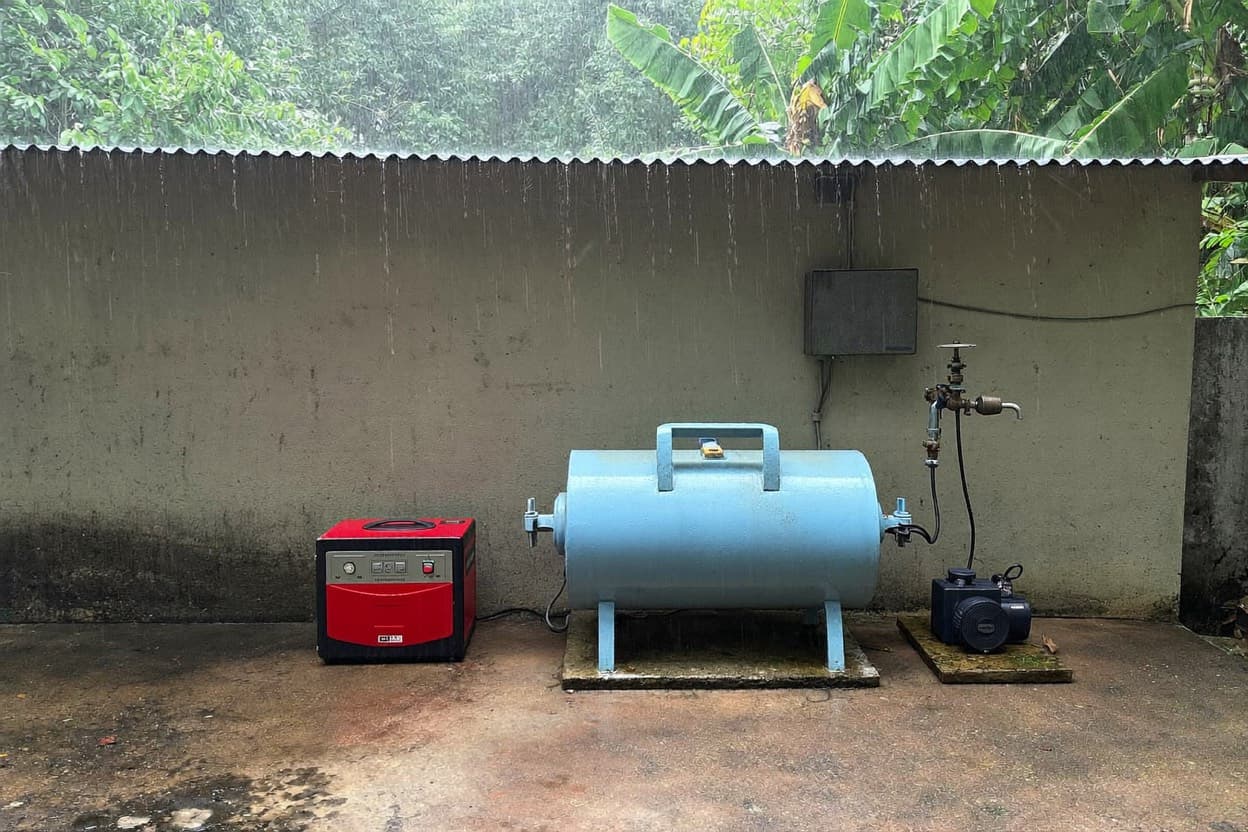
Island grids have moods. Storm season brings real outages, and the rest of the year contributes flickers and brownouts that last seconds but count. Since every drop of a well system's water moves by electric pump, the interesting question is not whether the power will drop, it will, but what your particular system does in the minutes and hours after it does.
What actually happens at the moment the grid drops
The pumps stop instantly, all of them. What happens at the taps depends on what sits between the pumps and the house. A system with only a pressure vessel keeps a few minutes of pressure, the bladder's stored volume, and then goes quiet. A system with an elevated tank keeps flowing by gravity for as long as the tank lasts, at gravity's modest pressure. A system where storage sits at ground level and a pressure pump feeds the house loses pressure almost immediately, because the stored water has no way to move itself. Same outage, three completely different evenings.
That is worth restating plainly: the outage experience is designed, long before any generator is bought. Storage volume decides how long the property could ride through, and the storage position decides whether any of it is usable without electricity.
The return of power is the dangerous part
Pumps mostly survive outages fine. What kills them clusters around the edges: the voltage sag and surge as the grid stumbles back, several restarts in quick succession as supply flaps, and the classic island failure, a submersible restarting into a well it has already pulled down, or a pressure pump restarting against tanks that emptied during the blackout and running dry. The protective hardware is neither exotic nor expensive: dry-run protection on every pump, a restart delay so the pump waits out the flapping, and voltage protection where the local supply is genuinely rough. On a system that already has a proper control box, most of this is configuration rather than new equipment.
Backup options, ranked honestly
Full storage is the first backup, and it is the one with no fuel, no noise and no moving parts. A property that keeps a genuine reserve in its tanks, positioned or plumbed so at least essential water flows without power, has already solved the common outage. Most blackouts end before a well-sized reserve does.
A generator is the right tool where outages run long or the property cannot tolerate low pressure, but it has to be sized for the truth about motors: a pump draws a large multiple of its running current in the instant it starts, and a generator chosen from the running figure alone will stall exactly when needed. Starting the pumps one at a time, or using soft-start and inverter-driven pumps that ramp instead of slamming, brings the requirement down substantially. Battery and inverter setups fill the small end usefully: they carry controls, gate and a modest pressure pump through short cuts silently, but pushing a submersible on batteries is a specialist sizing exercise, not an accessory purchase.
- First: storage with a reserve, positioned so essential water flows without power
- Second: protection hardware, so the outage and its messy ending cannot damage the pumps
- Third: a generator sized for starting current, not running current, where outages run long
- For rental villas: whatever the choice, guests judge the house by whether the shower worked during the storm
If the water already stopped and the tanks are dry, that is a different article, and a delivery truck solves today before any system change solves next time.
Deep Well Samui configures pump protection, storage and backup arrangements as part of complete water systems across Samui, Phangan and Koh Tao. If your last blackout ended with dry taps or a tripped pump, the system is asking for one of the fixes above, and a site visit will say which.