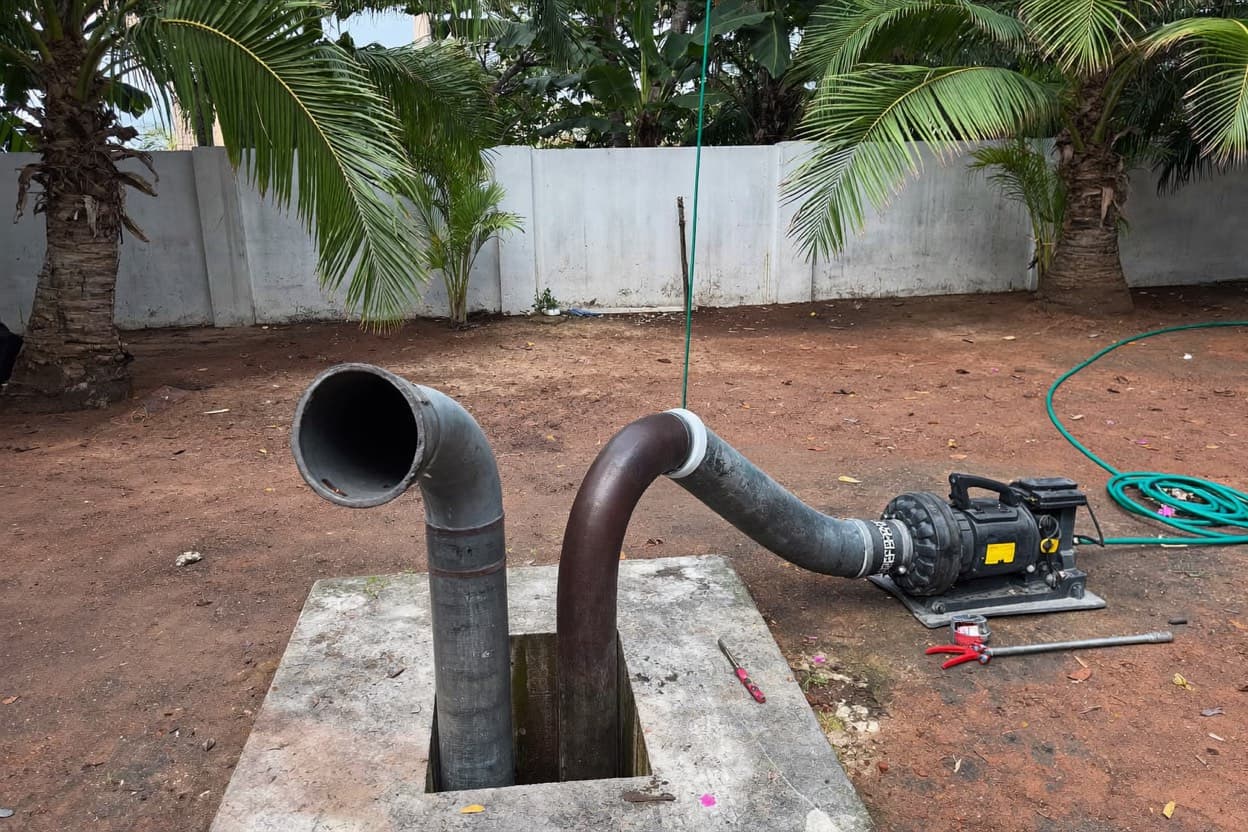
A well that was drilled properly disappears from its owner's attention, which is the point of drilling it properly. The risk is that it disappears for ten years. Boreholes age the way most machinery ages: slowly, quietly, and then expensively, with the expensive part usually landing in the driest month of the year.
Maintenance is how the quiet years stay quiet. Here is what actually wears, what a service visit covers, and how to tell a fading pump from a fading well.
Three things age at three different speeds
What sits in the ground barely ages: cased and screened correctly, the bore itself is the longest lived part of the installation. The machinery ages fastest, with the submersible pump as the hardest working component on the property, running under water, under load, most days of the year. Between them sits the interface, the screen and the formation around it, where the ground slowly deposits what the water carries.
Most owners maintain none of the three until the tap coughs. The result is that a wearing pump gets to fail completely, in high season, instead of being caught as a trend in an annual reading.
What an annual service visit covers
- Flow and pressure readings, compared against the well's baseline from commissioning
- The pump's electrical draw, the earliest honest signal of mechanical wear
- Pressure vessel charge and controller behaviour through a few cycles
- Filter cartridges and media, serviced on schedule rather than on complaint
- A water sample when the taste, staining or use of the property has changed
None of this takes long, and all of it is trend work: a single reading says little, the same reading a year apart says a lot. A pump drawing more current to move less water is announcing its retirement a season in advance, which is exactly enough notice to replace it in comfort rather than in crisis.
What an owner can watch between visits
The annual visit measures what cannot be seen from outside. Everything below can be noticed without tools, and noticing is most of the value. A dated note on a phone beats memory, because these faults arrive as trends rather than events.
- Pressure at the taps: steady, or sagging whenever two outlets run together
- The rhythm of the pump, which should be start, run, stop, with real rests in between
- The electricity bill, where a slow climb with no other explanation often means the pump is working harder than it used to
- Water appearance and smell: new cloudiness, sand, colour or odour that was not there before
- Damp or leaks around the wellhead, tank connections and pipe runs
- Tank refills, if there is storage, which should follow their usual pattern
A yearly visit suits a typical household. Some systems earn a tighter schedule: rental villas where a dry tap means refunds, resorts running near capacity in high season, wells with a history of sand or iron scale, and pumps already near the end of their expected life.
When the yield itself fades
A well that produces less than it used to has a short list of explanations. The pump may be worn. The screen or the formation around it may be silting or scaling up. Or the water level may simply be seasonally low, which is a calendar problem rather than a mechanical one. The three look identical at the tap and are completely different repairs, which is why the diagnosis starts by comparing today's behaviour with the well's original test pumping figures.
Fouled screens are recoverable. Wells are cleaned and redeveloped, the deposits are pulled back out of the interface, and a well that had faded over years often comes back close to its original figures. What cleaning cannot fix is a bore that was cased badly on day one, which is why the drilling decisions and the maintenance story are the same story told in two chapters.
The paperwork is half the maintenance
Two documents make every future problem cheaper: the borehole log from drilling, and the test pumping report from commissioning. Together they say how deep the well is, where the water enters, what it sustained when new, and how far the level drew down doing it. A technician holding them can diagnose most faults in one visit. A technician without them starts by rediscovering the well at your expense.
So how long does a well last?
Built and looked after properly, decades; the bores that fail young almost always trace back to casing shortcuts or a pump that was allowed to destroy itself. Which is the honest sales pitch for maintenance: it is not a subscription for its own sake, it is a pair of readings a year that converts every failure from an emergency into an appointment.
Deep Well Samui services wells across Samui, Phangan and Koh Tao, from annual checks against a proper baseline to cleaning, redevelopment and pump replacement when a well has already gone quiet.