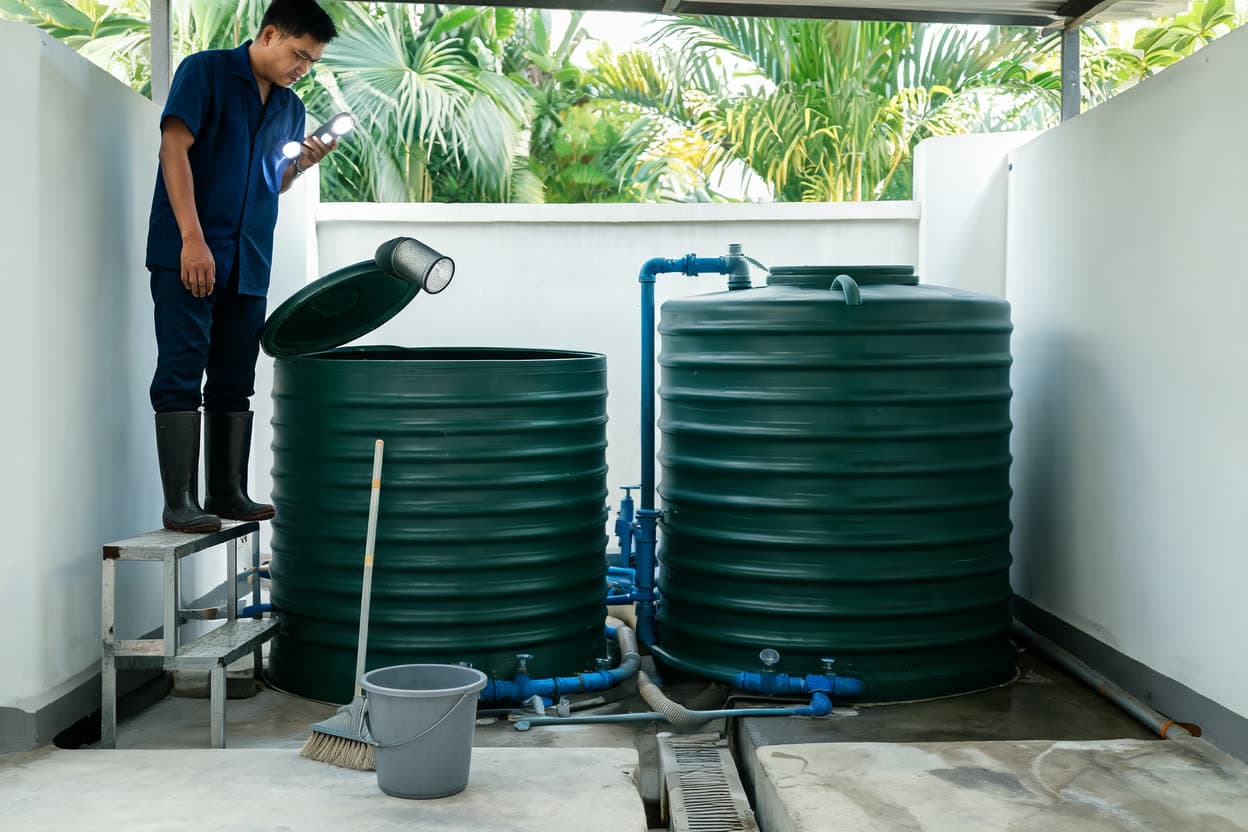
A storage tank is the quietest part of a villa water system. It has no motor, nothing to trip and nothing to reset, so it is the part nobody looks at until the water starts to smell, a tap runs cloudy after a storm, or a technician opens the lid during other work and finds a layer of silt on the bottom. Cleaning a tank is not difficult. Doing it safely, in the right order, and without disturbing the rest of the system takes a little more thought than a hose and a brush.
Why a tank gets dirty
Everything the water carries in settles where the water stands still. Fine sand and silt from the well, rust particles formed as dissolved iron meets air, and the residue of treatment all drop to the floor of the tank over months. Light and warmth encourage growth on the walls, which is why a thin or translucent tank in full sun turns green inside. Anything that gets past the lid, from dust and leaves to insects, adds to it. None of this shows from outside: a tank can look spotless and hold a dark layer across its whole base.
Raw-water and treated-water tanks collect different things. A tank fed straight from the well takes the sediment and iron before any filter sees them, so it loads up faster and its cleaning protects the treatment downstream. A tank after the treatment should stay much cleaner, and when it does not, that is a sign worth following up: something is getting through the filters, or into the tank from above.
Before you start: access and safety
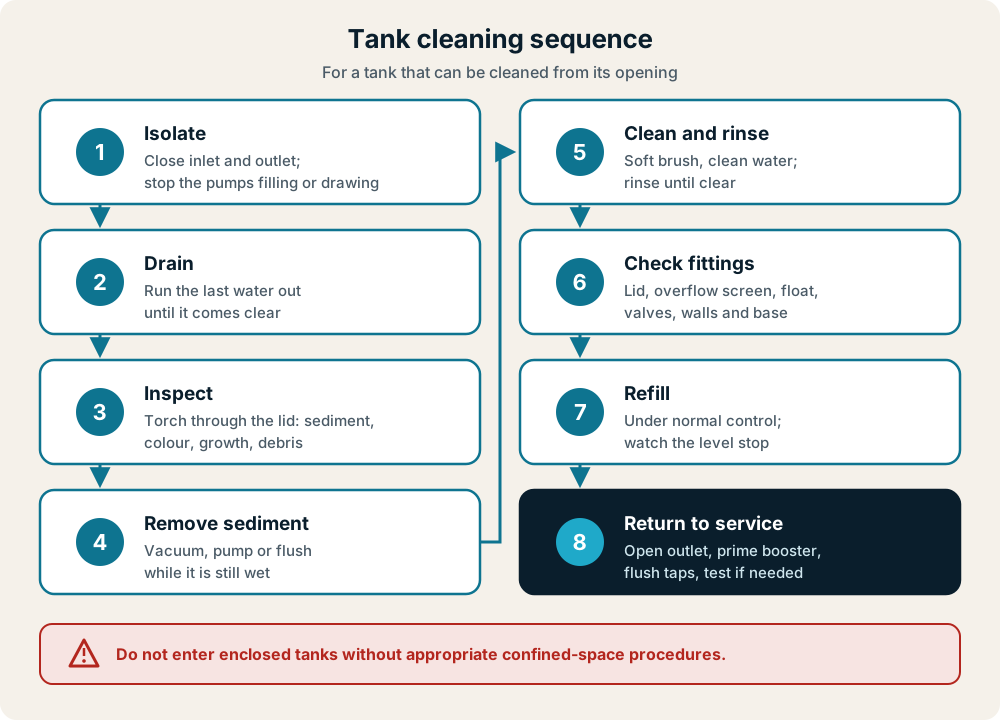
Most villa tanks are cleaned from the outside, through the lid, with long-handled tools and a hose. That is the method this guide describes. Entering a tank is a different matter. The inside of a tank is an enclosed space with poor ventilation, a slippery floor and often no easy way out, and people have been seriously harmed in exactly that situation. Underground tanks, concrete tanks and large tanks that cannot be reached from the opening should be cleaned by a crew equipped and trained for confined-space work, which includes a person outside at all times. If cleaning a tank properly seems to need someone inside it, that is the point to call a professional rather than improvise.
Isolate, then drain
The tank has to come off the system before it is emptied, otherwise the pump will try to refill it while you work, or the booster will pull air and sediment into the house. Close the inlet valve so the well pump cannot fill it, and close the outlet so the booster pump is not drawing from an emptying tank. Where the booster has a low-level cut-out, this also stops it running dry. If the house needs water during the job, a second tank or a temporary bypass keeps it supplied; if there is only one tank, choose a time when nobody needs water for a few hours.
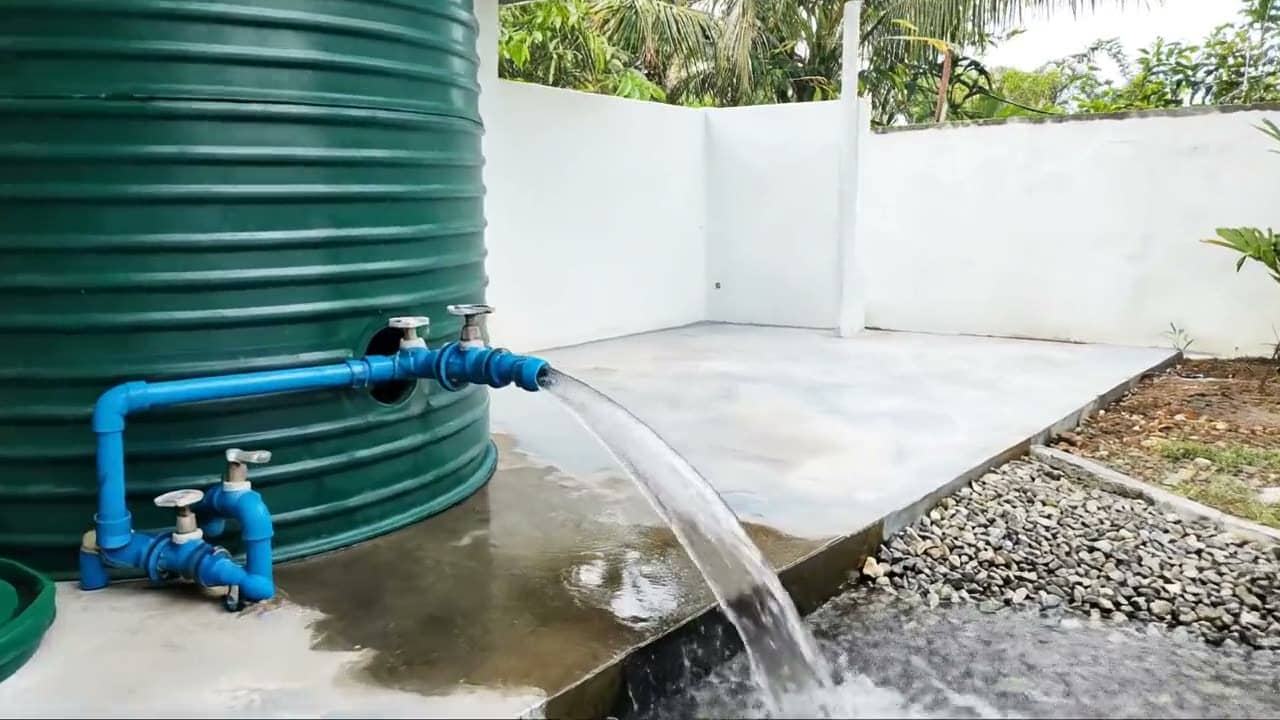
Drain through the bottom drain valve where there is one, or by pumping out. The last of the water is the useful part: it carries the loose sediment with it, so let it run until it comes clear rather than stopping at the first sign of an empty tank. Send the water somewhere that can take it. A gravel soakaway or a garden bed is fine for clean water; sediment-laden water should not go into the pool or back toward the wellhead.
Inspect before you clean
With the tank empty, look before touching anything. A torch through the opening shows how much sediment there is, what colour it is, whether the walls carry growth and whether anything has fallen in. Orange or brown sludge points to iron; grey or sandy material points to the well; green film points to light getting in. That observation is worth a photo and a note, because the next cleaning will tell you whether the problem is getting better or worse.
Remove the sediment, then clean the surfaces
Loose sediment is easiest to remove while it is still wet. A wet-and-dry vacuum, a small submersible utility pump or simply flushing it toward the drain with a hose all work on an accessible tank. The walls and floor can then be scrubbed with a long-handled soft brush and clean water. Use nothing that leaves a residue or scratches the surface: scouring the inside of a polyethylene tank only gives the next growth more to hold on to. If a disinfectant is used, it should be one suited to drinking-water tanks, applied as its instructions say, with the tank rinsed until no trace remains. Household cleaners and strong chemicals have no place in a tank that feeds showers and kitchens.
Rinse thoroughly, drain the rinse water the same way as the first drain, and repeat until the water leaving the tank runs clear.
Check the fittings while the tank is empty
- Lid: it should seal, sit level and be impossible for a child or animal to dislodge
- Overflow and vent: screened with fine mesh, intact, and discharging where overflow water cannot flow back in
- Float valve or level switch: moves freely and stops the inlet at the right level
- Inlet, outlet and drain: no weeping joints, valves that close fully
- Walls and base: no cracks, no soft or distorted areas, the base still level and supported
A torn overflow screen or a lid that no longer seals is usually how the debris got in, and fixing it does more for the next year than any amount of scrubbing.
Refill and return to service
Close the drain, open the inlet and let the tank fill under its normal control, watching that the float or level switch stops it where it should. Open the outlet only when there is enough water above the suction to keep the booster from drawing air. If the booster lost its prime while the tank was empty, it may need priming before it runs smoothly. Run several taps for a few minutes to move the first water through, then check the house for cloudiness or air. A water test afterward is worth it where the tank feeds drinking water or where the cleaning was prompted by a quality problem.
How often
There is no single interval. A raw-water tank on a well that produces fine sediment may need attention several times a year; a treated-water tank in the shade, fed through good filtration, may stay clean for a long time. What sets the frequency is the source water, the filtration ahead of the tank, the tank's material and exposure to light, how much sediment the last inspection found, and how the system is used. The practical approach is to inspect on a schedule, through the lid with a torch, and clean when the inspection says so. Note what you find each time so the interval settles on evidence rather than habit.
Deep Well Samui inspects and cleans storage tanks across Samui, Phangan and Koh Tao, including underground and enclosed tanks that need confined-space procedures, and services the whole system around them. If your tank has not been looked inside for a while, or the water has changed, an inspection will show what is there.