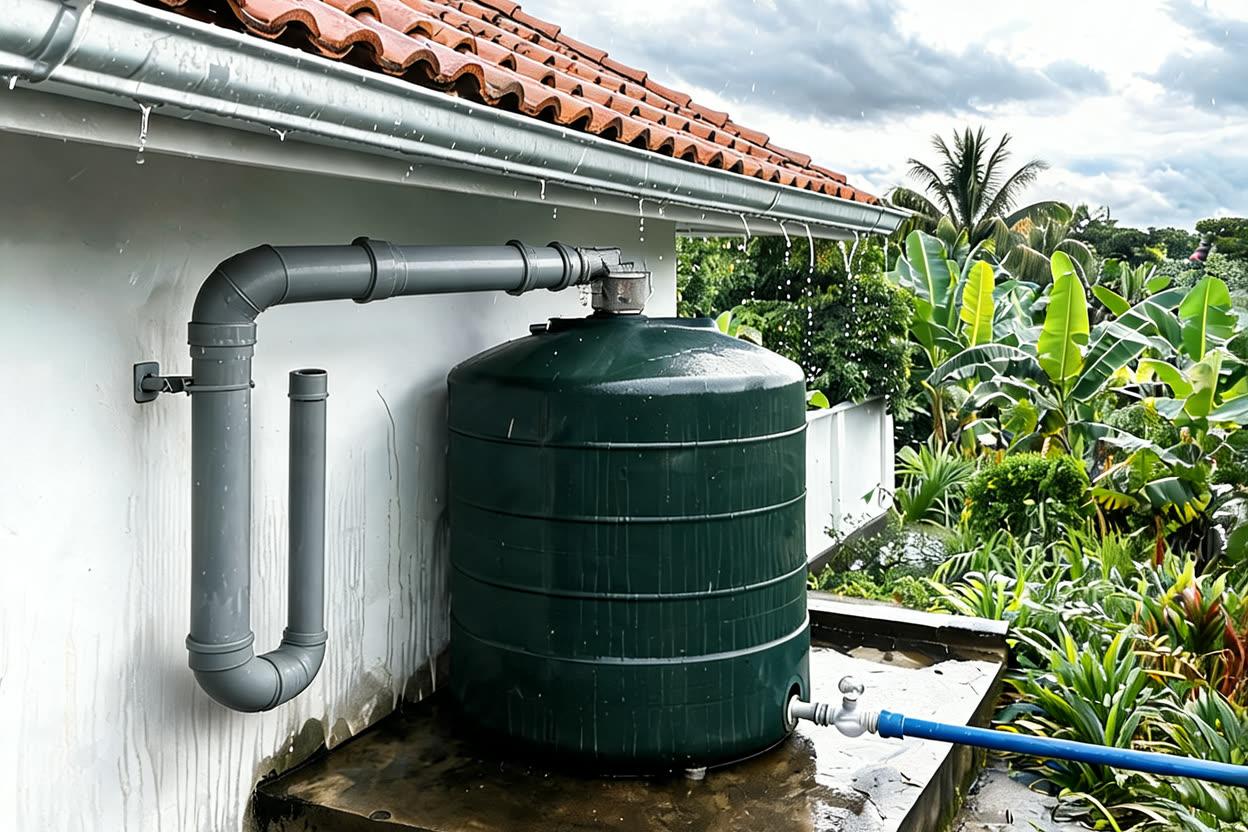
Every wet season the same thought arrives with the rain: all this water running off the roof, and the well pump still working. Rainwater harvesting is a reasonable idea on an island that gets heavy rain for part of the year. It is also widely misunderstood as an alternative to a well, which it is not. The useful question is narrower: what can rainwater take off the well, when, and what does it need to do that safely.
The timing problem
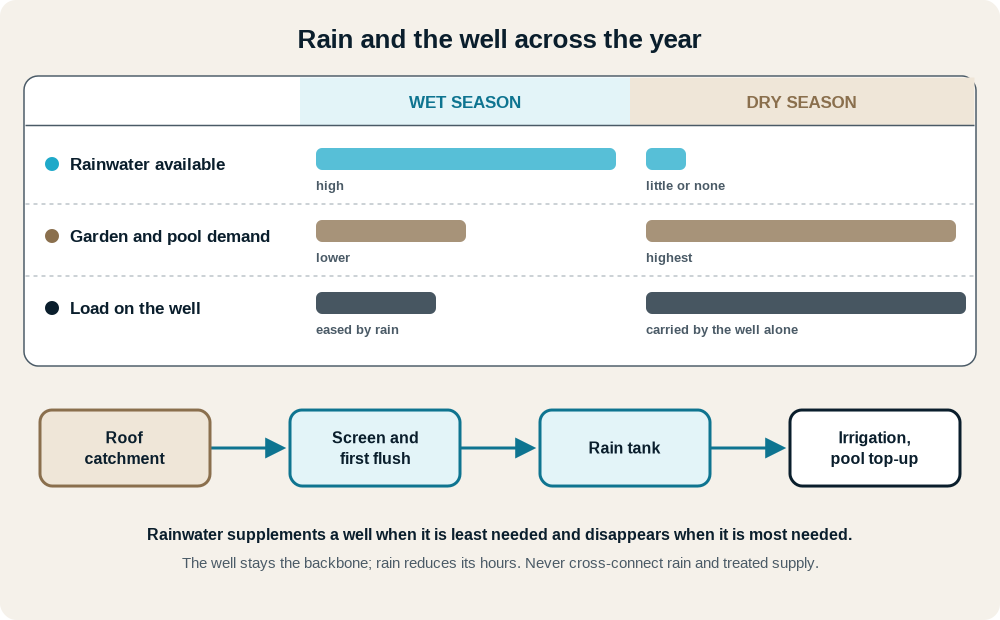
Rain on Samui, Phangan and Koh Tao is seasonal. For months it is abundant, then for months there is little or none, and the dry months are exactly when the garden, the pool and a full villa draw hardest. A rainwater tank is full when the well is under the least pressure and empty when the well is under the most. Storage shifts that mismatch by days or weeks, not by a season: to carry a villa through the dry months on rain alone would take a volume of tanks that no normal site can hold. This is why rainwater is a supplement on the islands and the well remains the source the property depends on.
What rainwater is good for
Used for the right jobs, harvested rain does real work. Garden irrigation is the natural fit: it is the largest seasonal draw on many villas, it does not need treated water, and in the wet months the garden needs less of it anyway, so a modest tank goes a long way. Pool top-up during the wet season is similar. Where a house is plumbed with a separate non-potable line, toilets and outdoor taps can run on rain. Each of those litres is a litre the well does not pump, which means shorter pump hours, less electricity, a well that recovers more fully between cycles and, on a bore with modest yield, more margin for the household itself.
What it takes to collect rain properly
A roof is a catchment, and it collects more than rain. Dust, leaves, bird droppings and insects all wash off with the first minutes of a downpour, so a working system puts something between the gutter and the tank:
- Gutters and downpipes in good order, with leaf screens that are actually cleaned
- A first-flush arrangement that diverts the dirtiest first run-off away from the tank
- A closed tank with a screened inlet and overflow, so light, debris and mosquitoes stay out
- An overflow that discharges somewhere sensible, away from foundations and the wellhead
- A roof and gutter material that does not shed anything you would rather not water the garden with
An open drum under a downpipe is not a rainwater system. On the islands it is a mosquito breeding site with a tap.
Keeping rain and treated water apart
Rainwater is soft and low in minerals, which is pleasant, but it is not clean. It has crossed a roof and sat in a tank, and it carries bacteria and organic matter that a well's treatment stage was never designed to handle. That sets the one firm rule in this subject: harvested rain stays on its own circuit, feeding irrigation, pool top-up or a dedicated non-potable line, unless it is brought into the household supply through the same treatment and testing discipline as any other raw water. What it must never do is join the treated supply through a casual connection, a garden hose left in a tank, or a valve someone opens in a dry spell. A single cross-connection undoes everything the treatment stage protects.
Sizing the tank honestly
A rain tank is sized by what it will supply between rains, not by how much the roof can deliver in a storm. In the wet season a tank refills often, so a moderate volume keeps the garden going; a bigger tank mostly overflows more. In the dry season the roof delivers nothing, so no volume short of absurd carries the property through. The practical sizing is therefore the wet-season irrigation and pool make-up between typical rains, plus the space and budget the site allows. The tank's material and placement follow the same rules as any other storage.
When it is worth doing
Rainwater earns its place on properties with a large roof, a thirsty garden, a pool, a well of modest yield, or all four. Resorts with extensive planting are the clearest case. It is a weak investment on a small plot with little garden, where the tank takes space the site does not have and saves water the well supplies easily. And it is never a reason to skip the well assessment, the storage or the treatment that the property would need anyway: for most of the year those are what the taps run on.
Deep Well Samui designs complete villa and resort water systems across Samui, Phangan and Koh Tao, with the well as the backbone and rainwater, where it makes sense, as a planned supplement with its own storage and its own circuit. If your garden or pool is driving the pump hours, we can tell you whether rain would take a useful share.