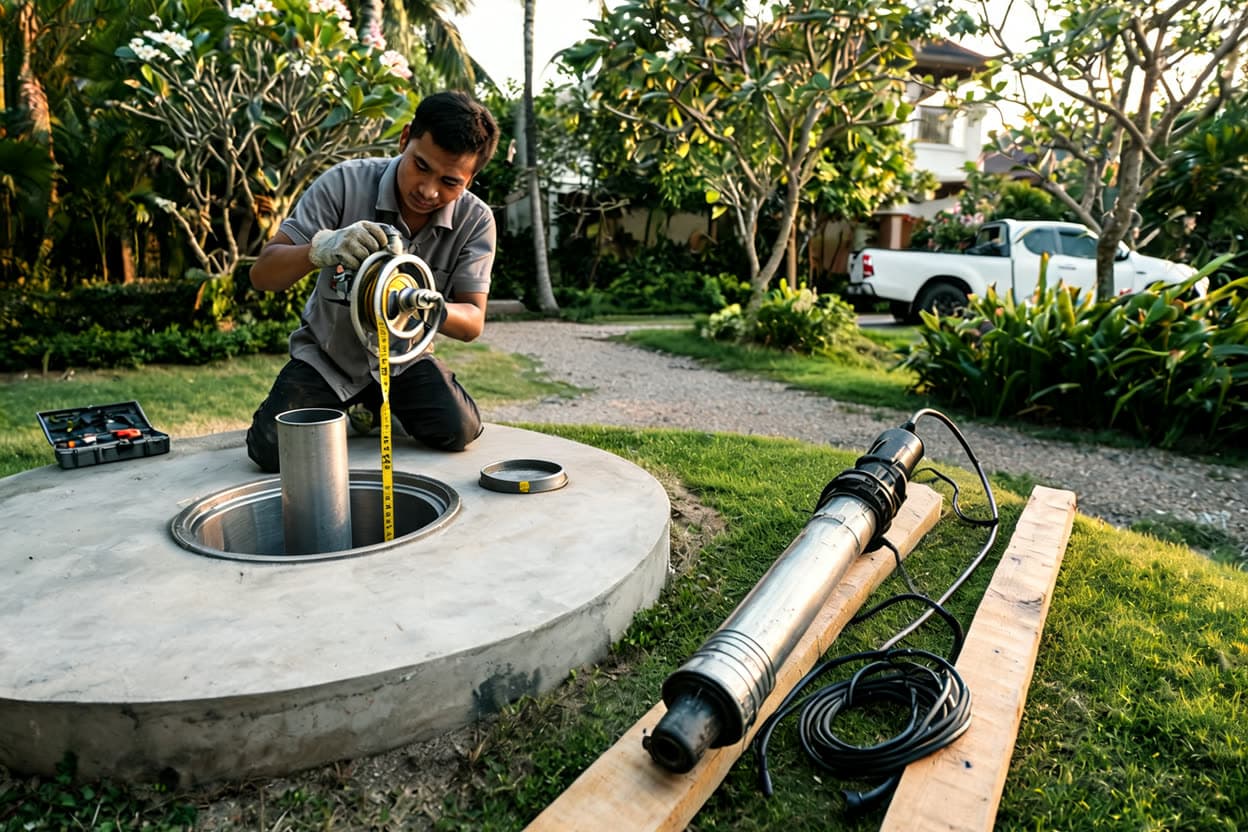
A well that used to keep the tank full now struggles to, or the water has turned cloudy, or the pump trips on its protection more often than it used to. Somebody suggests drilling a new one. Sometimes that is the right call. More often the well is not the problem at all, and when it is, cleaning and redeveloping it costs a fraction of a new borehole. The decision is worth making properly, because a new well drilled next to a misdiagnosed old one inherits whatever caused the trouble.
Lower performance has many causes
Less water at the tank can come from anywhere between the aquifer and the float valve. The pump may be worn, its impellers eaten by years of fine sand. It may be hanging at a depth that no longer suits the water level. The control panel may be tripping on a fault that has nothing to do with the well. A check valve, a riser joint or a buried pipe may be leaking. The screen or the formation around it may be clogged with mineral deposits or biological growth. The casing may be damaged. Or the groundwater itself may have moved, seasonally or for good. Each of these produces a similar symptom at the tap, and only the last two are about the well's construction.
Signs that the well itself is declining
- The pumping water level has dropped compared with the original test, at the same pumping rate
- Recovery after pumping takes noticeably longer than it used to
- The decline is gradual over seasons rather than sudden
- Sand or silt appears in water that used to run clear, together with lower yield
- A replacement pump, correctly set, did not restore the output
A sudden drop usually points to equipment: a pump, a valve, a cable, a control. A slow fade over a year or more points to the well or the aquifer. Seasonal change is a third pattern and is normal; a level that falls in the dry months and comes back with the rains is a well doing what wells do on an island.
The diagnostic sequence
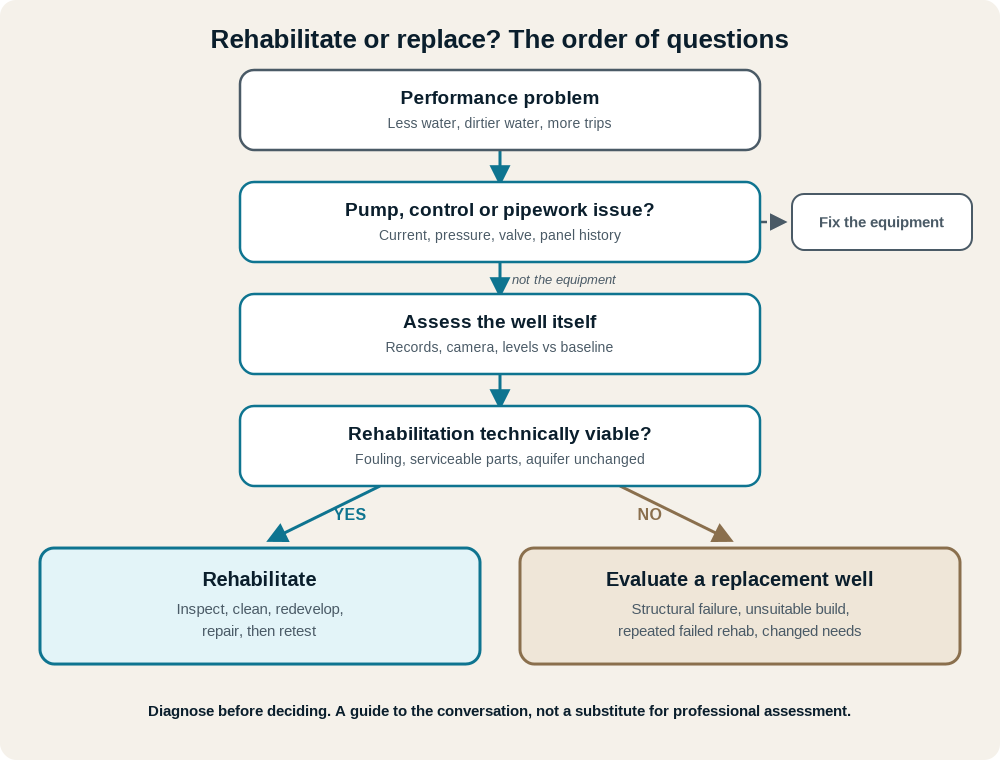
Start by pinning the symptom down: less water, dirtier water, more trips, or a combination, and since when. Then rule out the equipment, because that is the cheap end. Pump current, pressure, the state of the check valve and the panel's fault history say a great deal without anything being pulled from the well. Next, find the well's records: the drilling log, the original test pumping report and any later measurements. Then measure the well as it is now, ideally the same way it was tested when new: static level, pumping level at a known rate, and recovery. Comparing those with the baseline is the only objective way to say whether the well has changed, how much, and in what way.
Where the records are missing, the current measurement becomes the baseline from today, and a camera survey of the casing and screen can stand in for the construction details nobody wrote down.
What rehabilitation involves
Rehabilitation is a set of methods for restoring a well's ability to let water in. It usually begins with inspection, often by camera, to see what the screen and casing look like. Cleaning removes the deposits and debris that have built up; redevelopment then surges and pumps the well, much as it was developed when new, to pull fines and loosened material out of the formation around the screen. Serviceable components are repaired or replaced along the way: a worn pump, a corroded riser, a failed check valve. The well is then test pumped again, which is the only honest measure of what the work achieved. A well whose screen had fouled gradually often comes back close to its earlier figures. One whose aquifer has changed will not, however thoroughly it is cleaned, and nobody can promise the outcome before the retest.
When a replacement well is the reasonable answer
- The casing or screen has failed structurally, and the damage cannot be repaired in place
- The original construction was unsuitable: too shallow, screened in the wrong zone, or built without a proper seal
- Rehabilitation has been done properly and more than once, and the gains do not last
- The property's needs have changed so much that the well could never meet them, even restored
- The location itself is the problem: too close to a septic system, a flood path or the sea
A new well is not a guarantee of more water. It is drilled into the same ground, and if the old well declined because the aquifer did, a new one nearby starts from the same place. Where replacement is the right answer, the old well's history is the most useful input to siting and designing the new one, and the old bore should be properly decommissioned rather than left open.
Deep Well Samui assesses, cleans and redevelops existing wells across Samui, Phangan and Koh Tao, and drills replacements where that is what the evidence supports. If your well is not performing as it did, we start with the measurements, not the rig.